
REVIEW · 1-DAY TOURS
Salar de Uyuni 1 day + photo session + Sunset (English)
The most striking part of this day is the shift from rusty railway relics to the blinding white expanse of Salar de Uyuni, the world’s largest salt flat. You’ll see old locomotives, salt workers, giant cacti, bubbling salt-flat waters, and a sunset reflected in shallow water, all in one long outing.
I like the mix of human history and strange natural scenery. The train cemetery gives the day a rough, industrial opening, while Incahuasi Island offers a walk among giant cacti and a wide view across the salt. I also like the practical touches: food and drink are included, sunset wine is provided, and the driver-guide can leave you at your hotel, bus stop, or airport.
The main consideration is the length. You leave Uyuni for a full day and return around 8 p.m., with several hours in a 4×4. Incahuasi Island also depends on the rainy season, so you should book this knowing that part of the route may change.
Key points at a glance
- Rusty railway history: See more than 20 old locomotives and wagons linked to Bolivia’s early mineral railway.
- Colchani salt culture: Browse salt products and llama and alpaca fiber crafts near the edge of the flat.
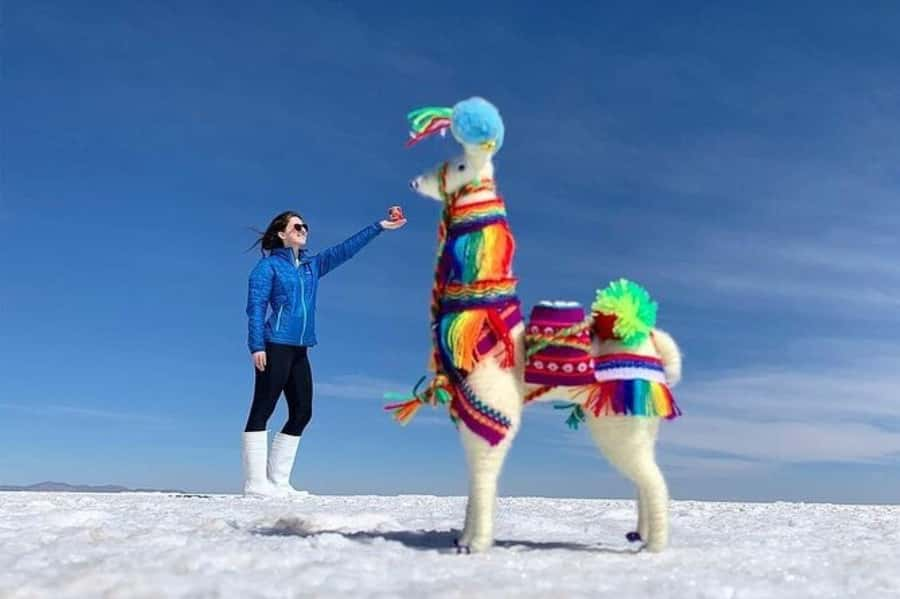
- Perspective photography: Use the enormous white surface for playful forced-perspective pictures.
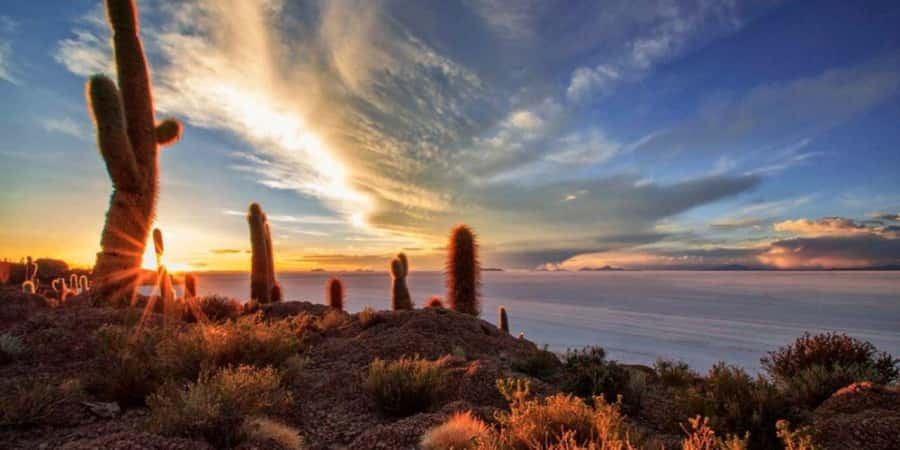
- Incahuasi Island walk: Spend more than an hour among ancient giant cacti if conditions allow.
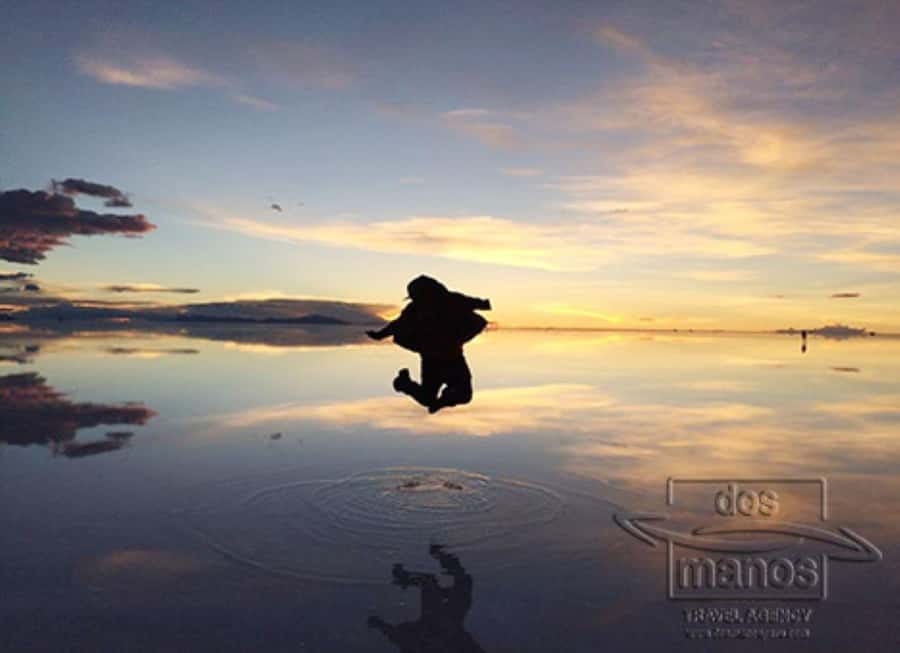
- Sunset with wine: Finish beside shallow water on the salt flat, with wine included.
- Flexible return: End the day at your hotel, the bus stop, or Uyuni Airport.
From steam locomotives to a sea of salt
This excursion works because the sights arrive in a clear sequence. You start with abandoned machinery, move through a salt-producing town, cross onto the flat itself, walk among giant cacti, and finish with reflected sunset light.
That order gives the day some shape. You are not simply driven to one viewpoint and driven back. Each stop explains a different side of the Uyuni area: industrial development, local production, prehistoric geology, high-altitude plant life, and the visual magic of water on salt.
The route runs by Toyota or Nissan 4×4. That matters here because the salt flat is enormous, and the day includes several separate stops rather than one short visit. Your guide drives and leads the visits, with service offered in English or Spanish.
Carlos is one guide associated with this experience. He is described as friendly, patient, and attentive to each person in the group. His habit of playing music from different countries adds a personal touch, especially on the long stretches between stops. That sort of care matters on a day when you spend a lot of time together in one vehicle.
More Evening Experiences in the world:
- Rhodes: E-bike Highlights Sunset or Morning Photo Tour
★ 4.9 · 351 reviews - Cappadocia Sunrise & Sunset Horse Tour with Photography
★ 4.9 · 348 reviews - Mediaeval Rhodes E-bike Highlights Photo Tour Morning/Sunset
★ 5.0 · 164 reviews
Train cemetery: Bolivia’s industrial past in rusted iron
The first major stop is the train cemetery outside Uyuni. More than 20 old locomotives and wagons sit scattered across the high plateau, their ironwork weathered by time and exposure.
These are not polished museum pieces. You can expect rust, open machinery, and a stark setting where the trains sit on frozen ground rather than inside a formal exhibition. The visual effect is strong: large industrial objects seem strangely out of place in the bare highland surroundings.
The railway story gives this stop more weight than a quick photo stop. In 1899, Bolivia’s first railway line was laid here, linking Uyuni with Antofagasta. It carried minerals including tin, silver, and gold, and the silver mines of Huanchaca helped make the railway a key part of Bolivia’s industrial growth.
I like this opening because it shows that Uyuni was not shaped only by salt. The railway connected mineral production with a wider trade network, and the abandoned locomotives preserve a rough reminder of that period.
Allow time to walk around carefully and look beyond the obvious locomotive shots. The machinery, wheels, and wagon frames offer plenty of photographic detail. The stop is exposed, so you’ll want protection from the highland sun and wind. The tour includes oxygen, but you should still take the day at a steady pace.
Colchani: salt blocks, workshops, and useful souvenirs
From the train cemetery, the route continues to Colchani, about 23 kilometers from Uyuni. This small town is closely tied to salt production and acts as a practical stopping point before you go farther onto the flat.
You can see a salt factory and displays connected with salt extraction. The visit helps explain how the white surface becomes a product people use, rather than leaving it as an abstract natural wonder.
Colchani is also a place to shop. Salt crafts make sense here, and you can find items made from llama and alpaca fiber. If you want a souvenir tied to the region, this is a more fitting place to look than a generic shop in town.
Keep your expectations in check. Colchani is not a long cultural visit with a full museum program. It is a short working-town stop, a chance to see local production, and a place to buy something small. Its value comes from context and timing.
Entering Salar de Uyuni, the world’s largest salt flat
The salt flat was formed by the evaporation of prehistoric lakes. Once you drive onto it, scale becomes the main event. The surface stretches far beyond the usual sense of a viewpoint, and the white ground can make distance and direction hard to judge.
The route includes places where salt is piled or extracted. These working areas connect the huge natural surface with the local economy. You are not just looking at a white plain. You are seeing a resource that is gathered, processed, and sold.
The tour also visits the Ojos del Salar, where water movement and gas emissions can be seen. These openings give the flat a little drama beneath its hard surface. The sight is different from the salt crust around it, and it helps you notice that the area is not simply dry and lifeless.
The Hotel or Salt Museum at Playa Blanca adds another stop. You can see flags from different countries and a Dakar monument, with lunch arranged during this part of the day. The stop breaks up the long drive and gives you a place to pause before continuing toward the center of the Salar.
Lunch and drinks are included, which improves the value of the $76 price. A full-day 4×4 outing can otherwise become expensive once food and transport are added separately. Entrance fees to attractions or museums are not included, so you should keep that extra cost in mind when comparing tours.
A few more photo experiences around the world worth a look
- From Yerevan: 6 Most Instagramable Armenian Sights Day Trip
★ 4.3 · 304 reviews - Day Trip to Chefchaouen from Fez (instagram /Photos)
★ 5.0 · 180 reviews - Birding & Photography Day Trip to Doñana from Seville
★ 5.0 · 61 reviews - Mt. Fuji Highlight Photo Spots One Day Tour from Tokyo
★ 4.5 · 36 reviews
Perspective photos in the middle of the Salar
The center of the salt flat is the main stage for perspective photography. The empty surface lets you play with distance, size, and angle, making people appear to stand inside a bottle, hold up a vehicle, or perform other comic tricks.
You do not need complicated equipment for this. The key is the open space and the patience to arrange the camera angle. Your driver-guide helps you reach a suitable place and can assist with the playful compositions.
This part will appeal most if you enjoy taking pictures rather than simply checking off a viewpoint. It can also be a good social moment, since the photos work best when people cooperate and try different poses.
The drawback is that a photo session can take longer than expected. If your group is enthusiastic, you may spend a fair amount of time waiting for setups or repeating shots. That is part of the fun for some people, but less appealing if you prefer a fast-moving sightseeing day.
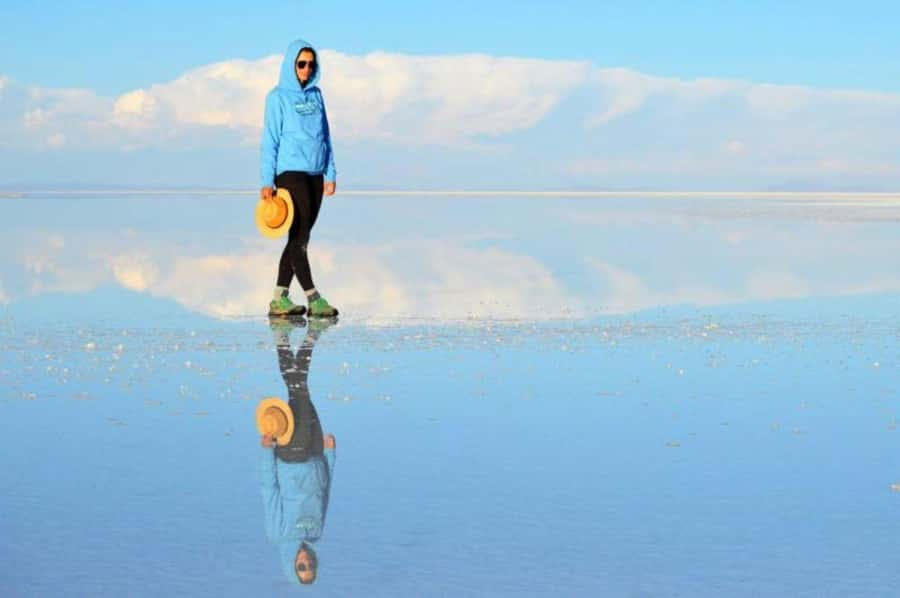
The flat can also look very different depending on conditions. In the dry season, the salt crust gives you the famous white expanse and geometric patterns. During the rainy season, a thin layer of water can create a mirror effect. The information for this experience specifically notes that the Incahuasi visit depends on the rainy season, so the exact route can vary with conditions.
Incahuasi Island and its giant cacti
Incahuasi Island is one of the day’s most unusual stops. It rises from the salt flat and is covered with giant cacti, creating a sharp contrast with the white ground around it.
You can walk along the island’s path for more than an hour. The route gives you time to look closely at the cacti and then turn outward for broad views across Salar de Uyuni. The Coral Window is another feature to look for during the visit.
I like this stop because it adds height and texture to a day that otherwise stays mostly flat. The cacti break the visual pattern of the salt, while the island’s higher points give you a better sense of how far the Salar reaches.
The walk requires more effort than the stops at Colchani or the train cemetery. You’ll want to move at a comfortable pace, particularly at high altitude. The exact visit depends on the rainy season, so do not treat Incahuasi as guaranteed in every set of conditions.
That uncertainty is the main weakness of this part of the outing. If the island is unavailable, the day still includes the train cemetery, Colchani, the salt flat, photo session, and sunset. Still, visitors who most want the giant cacti should confirm current conditions before booking.
Sunset beside water, with wine included
After Incahuasi, the 4×4 returns toward the edge of the Salar to find a place with water. The final stop is built around sunset and reflection.
When a shallow film of water covers the salt, the surface can reflect the sky and the people around you. The scene changes quickly as the light drops, so this is a good time to keep your camera ready rather than packing everything away after the earlier photo session.
Wine is included for the sunset. It is a small detail, but it gives the final stop a more relaxed feel after a long day on the road. Food and drink are included as part of the tour, while the sunset wine is called out separately as one of the extras.
You return to Uyuni at about 8 p.m. The provider can leave you at your hotel, a bus stop, or the airport. Airport pickup on the same day as the tour is also included, as is pickup from your hotel. These arrangements are useful if you are building the tour around a tight Uyuni schedule.
Still, do not plan an important connection too close to the 8 p.m. return. A day that depends on road conditions, weather, and sunset timing needs some breathing room.
What the $76 price gets you
At $76 per person, this is good value if you want a full day that combines the main Uyuni sights with food and a dedicated sunset finish.
The price includes:
- Toyota or Nissan 4×4 transport
- A professional driver-guide
- English or Spanish guiding
- Food and drink
- Wine at sunset
- Oxygen
- Pickup at your hotel
- Same-day airport pickup
- Drop-off at your hotel, bus stop, or airport
Entrance tickets to attractions or museums are not included. That exclusion is worth checking before you set your budget, especially if the Salt Museum or another stop charges an admission fee.
The value also depends on your appetite for a long day. If you want a short visit focused only on the salt flat, this outing may feel too packed. If you want to see the railway remains, salt production, cacti, photography sites, and sunset in one trip, the price covers a lot of ground.
The tour has a 4.8 rating from three reviews, including a five-star account that gives special attention to Carlos. The strongest praise focuses on his patience, friendliness, care for each person, and music from different countries. Those details suggest that the guide can make the long drive feel more comfortable, but guide assignments can change, so Carlos should not be treated as guaranteed unless confirmed at booking.
Who should choose this Uyuni day trip?
I would recommend this experience to you if you want the classic Salar de Uyuni sights in one day and like variety. It suits photographers, first-time visitors to Uyuni, people interested in railway history, and anyone who wants a sunset rather than a simple midday visit.
It is also a good fit if you value practical transport arrangements. Hotel pickup, airport pickup, and several drop-off choices make the outing easier to fit around a short stay.
You may want a different plan if you dislike long vehicle rides, prefer a slower itinerary, or want a detailed museum visit at every stop. The day is broad rather than deeply focused. It gives you a strong sample of the region, but it does not turn each location into a long guided study.
You should also think about the season. Incahuasi Island depends on rainy-season conditions, and the water for the sunset is an important part of the final scene. Ask about the current route if those two features are your main reason for booking.
Should you book it?
Book this tour if you want the biggest possible taste of Uyuni in one day, with transport, meals, perspective photos, giant cacti, and a wine-touched sunset included. The combination of the train cemetery and Salar de Uyuni gives the day more range than a salt-flat-only trip.
Skip it if you need a short, highly predictable outing or if paying separate entrance fees would stretch your budget. For most people with one free day in Uyuni, though, the route offers solid value, useful airport and hotel transfers, and a memorable finish on the salt.
FAQ
How long does the Salar de Uyuni tour last?
The tour lasts one day. You return to Uyuni at about 8 p.m.
What language is the guide?
The tour is available with a live guide in English or Spanish.
What vehicle is used?
Transportation is provided in a Toyota or Nissan 4×4.
Is food included?
Yes. Food and drink are included in the tour.
Is wine included?
Yes. Wine is provided for the sunset stop.
Are entrance tickets included?
No. Entrance fees for attractions or museums are not included.
Can I be picked up at the airport?
Yes. Same-day airport pickup is included, along with pickup from your hotel.
Where can I be dropped off after the tour?
You can be dropped off at your hotel, the bus stop, or the airport in Uyuni.
Just added around the world
- Private Vacation Photoshoot with Photographer in Myrtle Beach★ 4.0 · 9 reviews
- Traditional Japanese Costumes “Kimono”, “Yukata”, “Ryuso”, “Photograph Course “Hair Set & Lipstick & Kimono & Photography”★ 5.0 · 17 reviews
- Marco Island Photography Experience★ 5.0 · 7 reviews
- Capture Unforgettable Moments: Private Holiday Photography★ 5.0 · 52 reviews
- Hire Photographer, Professional Photo Shoot – Myrtle Beach★ 5.0 · 4 reviews
- Proposal Photoshoot Mykonos★ 5.0 · 2 reviews
- Mykonos Town Greece Photographer★ 5.0 · 16 reviews
- Private Instagram Tour | Mykonos Most Photogenic Spots★ 5.0 · 4 reviews
1-Day Tours, compared.
From Yerevan: 6 Most Instagramable Armenian Sights Day Trip
Read our review →
Day Trip to Chefchaouen from Fez (instagram /Photos)
Read our review →
Day trip to the island of Sommarøy through the Fjords
Read our review →
Birding & Photography Day Trip to Doñana from Seville
Read our review →
Mt. Fuji Highlight Photo Spots One Day Tour from Tokyo
Read our review →
Kanazawa private 1 day/Photoshoot by professional photographer
Read our review →
Lempuyang Gate of Heaven: Day Trip with a Photographer
Read our review →
Instagram-Worthy Mt Fuji & Lake Kawaguchiko Day Trip
Read our review →Browse the lists this tour appears in