
REVIEW · HANOI
Hanoi Street Photography in a Vintage Community
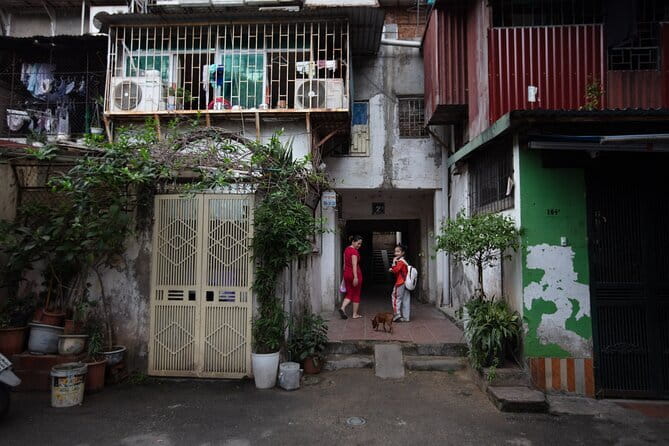
Hanoi’s old worker housing districts offer something rare: a close look at ordinary city life without the usual sightseeing backdrop. You’ll wander through narrow lanes lined with Soviet-inspired buildings, aging yellow walls, improvised cages, tangled wires, tea stalls, markets, and worn staircases.
I like the small maximum of four, which gives your instructor room to help with camera settings. I also like the range of subjects, from scooter repair shops and barbers to children and older residents using neighborhood playgrounds. The main drawback is that this is a working residential area, not a polished attraction, so the walk can feel rough, crowded, and visually chaotic.
Key points
- A rare look at everyday Hanoi: Photograph a real residential district far from the city’s standard sightseeing route.
- Small groups of four: You get more time for personal photography advice and questions.
- Strong variety in one short outing: Expect housing blocks, markets, tea stalls, repair shops, playgrounds, and street scenes.
- Guides with photography skill: Past guides named Mike, Son, and James have helped with camera settings and local context.
- Useful transport and a break included: Pickup is offered, an air-conditioned vehicle is provided, and coffee or tea is included.
- A four-hour commitment: The session fits neatly into a morning or afternoon, though lunch and dinner are not included.
Entering Hanoi’s old worker neighborhoods
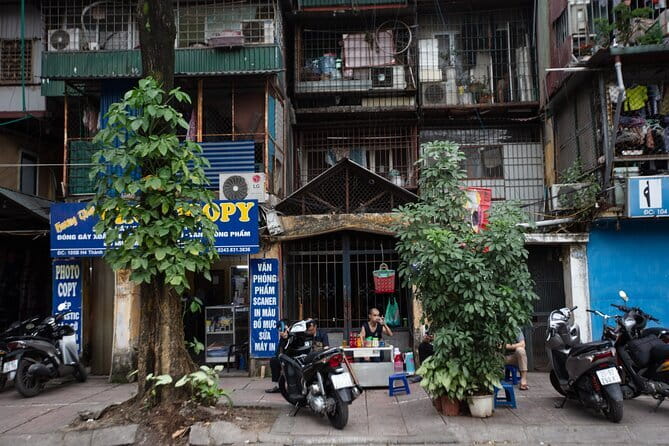
The heart of this experience is a residential district built during a period of major change in Hanoi. After the French left Vietnam, older housing areas were developed for working people. Some of these buildings date to the 1950s, while the wider State-built housing program expanded during the 1960s.
The design drew from Soviet housing models: practical blocks, shared spaces, narrow passages, and simple construction. Time has added its own layer. Walls have faded, staircases have worn smooth, electric wires have multiplied, and residents have adapted every spare corner to daily needs.
That gives you a subject very different from Hoan Kiem Lake or Hanoi’s grand colonial buildings. Here, the interest is in how people use space. A narrow lane may lead to a tiny tea stall, a market, a repair shop, or a playground surrounded by apartment blocks.
You should come ready to photograph details as well as broad scenes. The most effective images may be a yellow wall beside a dark stairwell, a row of cages hanging outside a home, or an older resident resting by the road. This is less about collecting famous views and more about noticing how a neighborhood works.
More Street Photography Tours in Hanoi:
- Hanoi Street Photography with a Pro – Phone & Camera
★ 5.0 · 27 reviews - Cultural Hanoi Photo Walk – A Street Photography Tour
★ 5.0 · 6 reviews - Hanoi street photography workshop with Fujifilm Global Ambassador
★ 5.0 · 2 reviews
A four-hour walk through ordinary city life
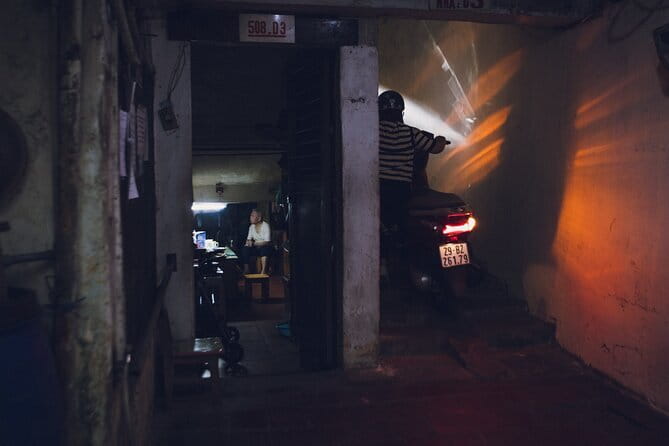
The exact route can vary, but the main outing centers on the old residential area and its maze of lanes. Your guide leads you through the neighborhood while pointing out useful positions and subjects.
The architecture is an important starting point. The housing blocks are not grand, but they tell a clear story about urban planning and public housing. Their plain lines and repeated forms make good subjects for patterns, contrast, and human scale.
Look for the way residents have changed the buildings over time. Balconies, stairways, doorways, wiring, signs, and small additions give each section a different feel. The area works well for black-and-white photography, but bright painted walls, clothing, market goods, and signs can also reward color photography.
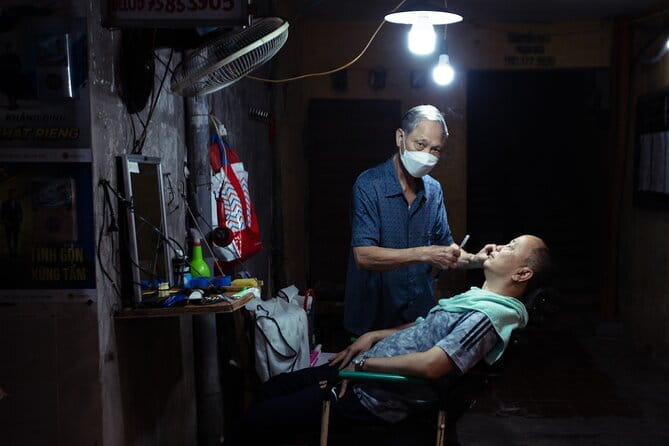
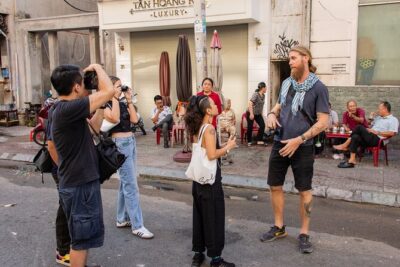
The route then moves into more active public spaces. Roadside tea stalls provide quiet scenes, often with people sitting and talking beside the lane. A scooter repair shop or barber shop offers a more focused subject, with tools, vehicles, mirrors, and working hands.
Markets add movement and sound. You might find crowded displays, shoppers, narrow passageways, and strong changes in light. A market is also where you need to be most aware of personal space. Your guide can help you decide when a scene is suitable for a photograph, but you should still act with care and avoid treating people as scenery.
Playgrounds offer another side of the neighborhood. Children and older residents may be playing or relaxing there, giving you a chance to photograph shared community life rather than only buildings and objects. The mix of generations helps explain why these old districts still matter to Hanoi.
What the photography instruction adds
This is not simply a walk with a camera. A photography instructor comes along, and the small group makes it easier to ask practical questions as scenes appear.
Mike is one guide named in past bookings, and visitors who joined him received help with camera settings while photographing Hanoi. Son has also led the photography work, combining image-making with explanations of local culture. James has guided outings that paired an older Hanoi housing district with other subjects such as street markets and community life.
Guide availability may vary, so you should not book expecting a specific person unless the operator confirms it. Still, the repeated presence of experienced photography guides is an important part of the value. You are not left to walk around hoping that a good picture appears.
The instruction should be especially useful if you are unsure how to handle mixed light, narrow spaces, or fast street scenes. A lane may be shaded while the market beyond it is bright. A person may move quickly through a doorway. A skilled instructor can help you think through shutter speed, exposure, framing, and timing as the scene unfolds.
You do not need to be an expert. The activity is suitable for people who want to make better pictures, and it can also work for those who simply want to see Hanoi through a camera. If you do not bring a camera, the experience can still offer a close look at local life, but the photography guidance will naturally be less useful.
Why the small group matters
The maximum group size is four. That is a major advantage in a neighborhood made of tight passages and small public spaces.
A large group would be awkward here. It could block a lane, crowd a tea stall, or make local people feel watched. With only a few participants, you can stop without creating a street parade, and the instructor can spend more time with each person.
Small groups also help with different skill levels. One person may need help choosing a lens or setting exposure, while another may be looking for a stronger composition. Four people still provide some company, but the outing should feel more personal than a standard city tour.
The tradeoff is price. At $98 per person, this is not a cheap sightseeing walk. You are paying for the guide’s time, photography knowledge, transport, and a specialized route rather than simply paying for entry to a site.
For someone who wants only a general introduction to Hanoi, the cost may feel high. For a photographer who values personal instruction and access to a less familiar part of the city, the price is easier to justify. Group discounts may also improve the value if you are booking with companions.
A few more photo experiences around Hanoi worth a look
- Instagram Incense Quang Phu Cau Village Tour with Train Street
★ 5.0 · 323 reviews - Hanoi Private Photoshoot – Iconic Spots & Hidden Gems
★ 5.0 · 118 reviews - Hanoi Instagram Tour: The Most Scenic Spots
★ 5.0 · 94 reviews - Hanoi: Instagram-Worthy Tour of City’s Most Scenic Spots
★ 4.9 · 69 reviews
Pickup, transport, and the practical pace
Pickup is offered, and the experience includes an air-conditioned vehicle. That matters in Hanoi, where heat, traffic, and humidity can make a long approach less pleasant than expected.
The vehicle does not replace the walking portion. The main subjects are found on foot, inside the neighborhood’s lanes and shared spaces. You should expect to move between different parts of the district, stop often, and spend time standing while waiting for the right moment.
Coffee or tea is included. That fits the character of the outing and gives you a short pause during the session. Lunch and dinner are not included, so plan a separate meal before or after the four-hour activity.
The duration is approximately four hours. That is long enough to cover several types of scenes without taking over your whole day. You can schedule it alongside other Hanoi plans, but leave enough room for pickup, traffic, and the walking pace rather than treating the four hours as an exact door-to-door guarantee.
A mobile ticket is available, which keeps the booking simple. Confirmation is provided at the time of booking. Since pickup details are not specified here, confirm the meeting arrangement and pickup timing before the day of the tour.
Photographing a lived-in place with care
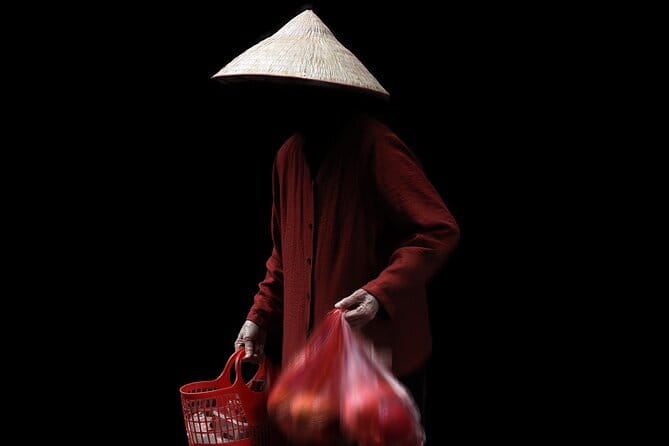
This neighborhood is valuable because it is not arranged for sightseeing. People are going about their routines, and the buildings are homes, workplaces, and shared spaces.
That also creates a responsibility. Ask before making an obvious portrait when possible, especially inside a shop or near a private doorway. A quieter approach usually produces better photographs anyway. People tend to relax when you are not rushing at them with a camera.
Your guide can help with local interaction, but you remain responsible for how you photograph. Avoid blocking entrances, market stalls, or narrow stairways. If a person does not want to be photographed, move on.
The raw setting can be visually tempting. Peeling paint, tangled wires, old staircases, and crowded lanes make strong compositions, but they also reflect real living conditions. Try to photograph the neighborhood as a place with residents and routines, not merely as an old backdrop.
This is one reason the experience can be more rewarding than a quick photo stop. You have time to see repeated patterns and small changes. A first pass may reveal architecture. A second look may show the person sitting in the doorway or the way a shop uses the edge of the lane.
Who will get the most from this outing
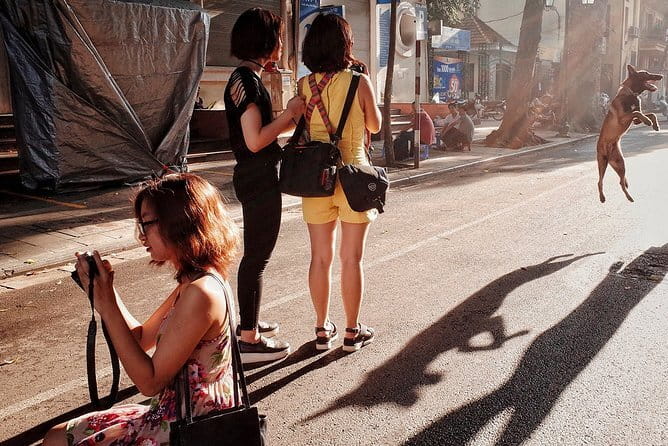
I would recommend this experience most strongly to photographers who want a personal look at Hanoi beyond the familiar center. It suits people interested in street photography, architecture, documentary images, and everyday culture.
It is also a good choice for visitors who prefer a small group to a large sightseeing party. The maximum of four means you can ask questions, adjust your approach, and stop for a photograph without holding up a crowd.
You do not need advanced equipment. A phone, compact camera, mirrorless camera, or digital SLR can all be used. The important thing is that you want to pay attention and make images rather than simply pass through.
This may be less suitable if you want famous landmarks, carefully staged portraits, or a relaxed vehicle-based tour. The setting is old and active, with uneven visual clutter and ordinary urban wear. That is the point, but it will not appeal to everyone.
It can also be a good fit for couples or friends with different photography levels. One person can focus on learning settings while the other works on composition. The small group and instructor make that easier than an independent walk.
How the $98 price measures up

The $98 price includes the photography instructor, air-conditioned transport, coffee or tea, and a four-hour outing. It does not include lunch or dinner.
The strongest part of the value is access to a specialized route and direct instruction. You are not just paying to enter an attraction. You are paying for help finding photographs in a part of Hanoi that can be difficult to understand on your own.
The price is less attractive if you plan to take only a few casual snapshots. You can walk through many Hanoi neighborhoods independently at little cost. In that case, the guide, transport, and photography advice may not justify the fee.
For a serious hobby photographer, though, the cost can make sense. The guides have helped people improve camera settings, find meaningful scenes, and connect the physical appearance of the neighborhood with its social history. A private booking, when available, can offer even more attention, though the listed group limit already keeps the outing small.
Booking details worth noting
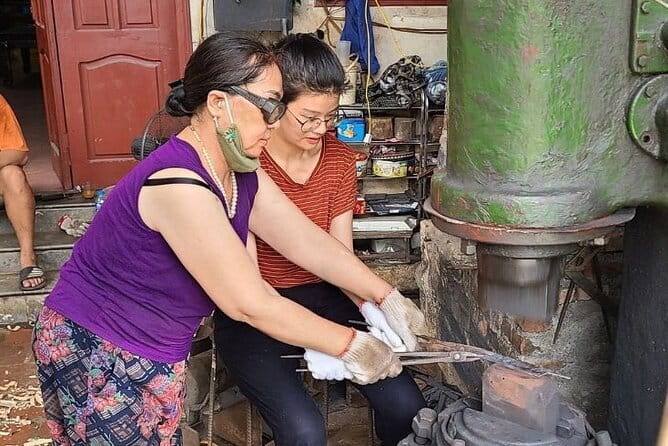
Free cancellation is available if you cancel at least 24 hours before the local start time. Cancellations made less than 24 hours in advance are not refunded, and changes within that period are not accepted.
Most people can participate, and the group is capped at four. Pickup is offered, but you should confirm the exact pickup arrangement after booking.
The experience has a perfect five-star rating from six published ratings, with particular praise for the guides’ photography help, cultural explanations, and choice of neighborhoods. The strongest pattern is clear: the quality depends heavily on the guide, so ask who is scheduled and share your photography interests at the start.
Should you book Hanoi Street Photography in a Vintage Community?
Book it if you want to photograph real Hanoi life, prefer a small group, and value guidance with camera settings and composition. The old worker housing, tea stalls, markets, repair shops, and playgrounds give you far more than a standard landmark tour.
Skip it if you want polished sights, a low-cost walk, or a fixed list of major monuments. At $98, the experience earns its price through personal instruction, transport, and access to an everyday neighborhood rather than through famous attractions.
For photographers, this is a strong choice. Bring a camera you know how to use, keep your eyes open for small scenes, and give the neighborhood the respect you would give any lived-in place.
FAQ
How long does the photography experience last?
The experience lasts approximately four hours.
How many people can join the group?
The activity has a maximum of four participants.
Is hotel or location pickup available?
Pickup is offered. The specific pickup details are not provided, so confirm the arrangement when booking.
What is included in the price?
The price includes a photography instructor, an air-conditioned vehicle, and coffee or tea.
Are meals included?
No. Lunch and dinner are not included.
Can I cancel for a full refund?
Yes, if you cancel at least 24 hours before the experience start time, based on local time. Cancellations made less than 24 hours in advance are not refunded.
Just added around Hanoi
- Tho Ha Handicaft Village – Private Hanoi Photo Tour★ 5.0 · 2 reviews
- Vietnam Fishing village photography tours★ 5.0 · 3 reviews
- Instagram Tour Duong Lam Ancient Village with Train Street Visit★ 5.0 · 3 reviews
- Ultimate Quang Phu Cau Photo Experience★ 5.0 · 13 reviews
- Ultimate Hanoi Photography Tour★ 5.0 · 19 reviews
- Private Photo Session with a Local Photographer in Hanoi★ 5.0 · 2 reviews
- Photography Tour to Tho Ha – The rice paper making village★ 5.0 · 4 reviews
- Hanoi by Night Photo Tour★ 5.0 · 4 reviews
Street Photography Tours, compared.
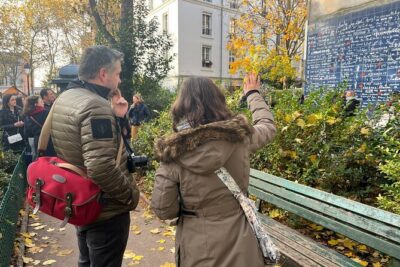
Learn the art of street photography in the heart of Montmartre!
Read our review →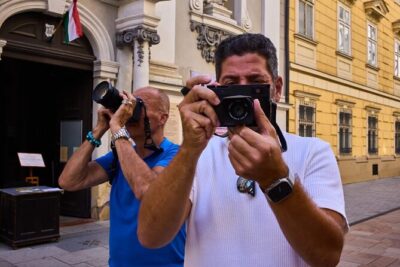

Hanoi Street Photography with a Pro – Phone & Camera
Read our review →
Street photography with your smartphone, tour of Budapest
Read our review →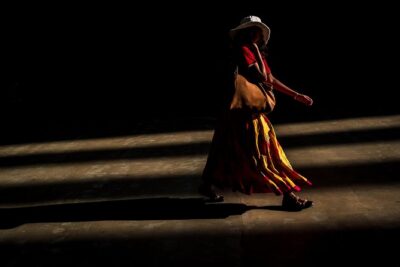
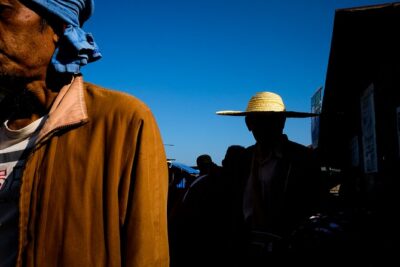
Cultural Hanoi Photo Walk – A Street Photography Tour
Read our review →Browse the lists this tour appears in