
REVIEW · LONDON
History of London Photography Tour
London reveals itself especially well through a camera. On this two-hour walk, you move from the old financial district to the South Bank, photographing Hawksmoor’s St Mary Woolnoth, St Paul’s Cathedral, Millennium Bridge, and Tate Modern along the way. The guide adds short history lessons, then helps you make better choices about framing, light, and camera settings.
I like two things here. First, the route mixes grand landmarks with less expected city corners, so you are not simply collecting the usual postcard views. Second, the teaching is hands-on. Guide Richard, mentioned by name in the tour feedback, helped photographers who had lost touch with manual settings, while still keeping the session friendly for beginners.
The main consideration is the route’s focus. Most stops are famous London sights, and one unhappy participant expected more rare viewpoints. Also, the tour is non-refundable, depends on good weather, and requires a minimum number of bookings before it runs.
Key points at a glance
- A two-hour photographic walk: Follow a compact route from St Mary Woolnoth in the City to Tate Modern on the South Bank.
- Useful camera coaching: Get help with composition, lighting, camera settings, and finding stronger angles.
- History in manageable portions: Learn about Roman religious traces, the Blitz, London’s churches, and the city’s great buildings without sitting through a formal lecture.
- A route with changing subjects: Photograph ornate churches, classical financial buildings, Gothic architecture, riverside views, bridges, monuments, and a former power station.
- Small maximum group: The tour allows up to 18 people, which matters when several people need help with their cameras.
- A good fit for mixed abilities: The experience is designed for locals and visitors, from people using camera phones to photographers with SLR cameras.
From ancient worship to London’s financial district
Meet at IMPRINT Church London, St Mary Woolnoth, at 10 to 13 Lombard Street. This puts you right in the City of London, a useful starting point because the first part of the tour is packed with architectural contrast.
St Mary Woolnoth has been used for worship for at least 2,000 years. Traces of Roman and pagan religious buildings were found under the present church, which was rebuilt in 1727 to a design commissioned from Nicholas Hawksmoor. You can photograph the church as a historic object, but the real lesson is learning how to frame it among the modern financial district around it.
Your guide helps you consider more than simply pointing the camera at a doorway. Look for the relationship between the church’s heavy design and the surrounding streets, then try different compositions. If you use a phone, you can still work on viewpoint and balance. If you bring an SLR, the guide can help you move beyond automatic settings.
The tour does not include admission fees at the stops, and this is primarily an outdoor photography walk. You should expect to spend about 10 minutes here, enough time for a short introduction, a few photographs, and some historical context.
More Photography Tours in London
- Private Tour: Night Photography Tour in London
★ 5.0 · 48 reviews - Private Night Photography Tour in London
★ 5.0 · 29 reviews - Photography Tour walking the back streets of London’s West End (3 hours)
★ 5.0 · 24 reviews
Photographing the Royal Exchange and Bank of England
The next stops bring you into the heart of London’s old commercial center. The Royal Exchange gives you a grand architectural subject and a chance to work on symmetrical compositions, lines, and scale.
After that comes the Bank of England, where you have about 15 minutes to study a building filled with architectural detail. The guide’s job is not just to identify the building. You get help finding angles that make the subject work as a photograph.
This is where the tour’s teaching can be most useful. Large buildings can look flat when photographed from the first available viewpoint. Your guide may encourage you to change your position, watch the available light, or include nearby street details to give the image more context. The supplied information specifically highlights advice on composition and lighting, so expect practical instruction rather than a purely historical walk.
The financial district also gives you a useful lesson in photographing London as it really is: old churches and grand institutions sit among office buildings, traffic, and narrow streets. You may not get a quiet, isolated picture at every stop. That is part of the challenge, and it can lead to a more truthful image of the City.
Gothic Guildhall and the bells of St Mary-le-Bow
Guildhall brings a different style. This 800-year-old building offers Gothic architecture, strong vertical lines, and plenty of texture. You have roughly 15 minutes here, making it one of the longer stops.
I would use this time to slow down. Gothic buildings reward close attention to details, not just wide views. Look for arches, stonework, shadows, and repeated patterns. Your guide can help you decide whether a broad architectural photograph or a tighter detail will make the stronger image.
St Mary-le-Bow follows with about 10 minutes. According to London tradition, a true Cockney must be born within earshot of its bells. That small piece of local culture gives the photograph some context, even if you have never heard the bells yourself.
This stop also shows the tour’s balance between familiar sights and less obvious photographic subjects. You are still visiting a known London church, but the focus is on how to see it differently. The aim is not to rush past another landmark, take a quick snapshot, and move on.
St Paul’s Cathedral and the weight of London history
St Paul’s gets the longest stop, about 20 minutes. It is one of the main visual rewards of the route, and the guide helps you make memorable photographs of the cathedral.
The building has witnessed major moments in British history. The information provided for the tour points to the 1501 marriage of Catherine of Aragon to Prince Arthur, Queen Elizabeth I’s visit after the defeat of the Spanish Armada in 1588, and the execution of Guy Fawkes and his fellow plotters after the Gunpowder Plot.
You do not need to memorize all of that to enjoy the stop. The useful point is that St Paul’s is both a building and a national symbol. A good photograph can show its scale, its setting, or a small architectural feature that says something about the whole structure.
With 20 minutes, you have time to try more than one approach. A wide shot may show the cathedral’s place in the City. A closer image may emphasize stone, columns, or the curve of the dome. Your guide can suggest camera settings and composition choices, which is particularly helpful if you normally leave your camera on automatic.
St Paul’s is also a very familiar subject. That means the tour cannot promise a completely unknown view, but it can help you make your version more personal.
More Photography Tours in the UK
- London Photography Tour – Private Tour
★ 5.0 · 17 reviews - London: Iconic Sights Photo Walking Tour
★ 4.9 · 12 reviews - Iconic London Photo Walking Tour
★ 4.6 · 11 reviews - Private Tour: Photography Walking Tour from Trafalgar Square to Covent Garden
★ 5.0 · 5 reviews
The Firefighters Memorial and the move toward the river
The National Firefighters Memorial provides a change of mood. Sculptor John Mills created the monument to honor the professional firefighters, men, and women who helped London endure the Blitz.
The tour describes these firefighters as the heroes with grimy faces, a phrase associated with Winston Churchill. You can photograph the statue as a strong human subject, then place it against London’s larger landmarks for a sense of scale.
This is a useful exercise because monuments can be difficult to photograph well. A straight-on picture may feel ordinary. Your guide can help you look for a more dramatic angle, and the surrounding city gives you options for background and context.
From here, the route continues toward the Thames and Millennium Bridge. The changing setting matters. You move away from the tight streets and stone buildings of the City into a place with more open views, strong lines, and reflections. That variety helps you build a more interesting personal set of London photographs within a short time.
Millennium Bridge, Tower Bridge, and river views
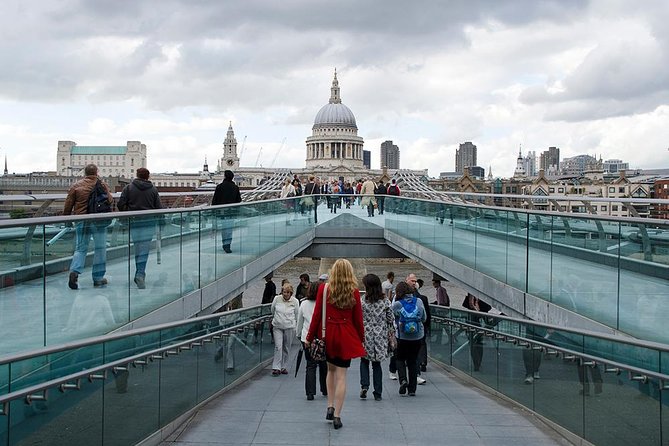
The Millennium Bridge is 325 meters long and links Tate Modern with the City of London and St Paul’s Cathedral. It opened on June 10, 2000. Its long, clean form is made for photographs, particularly when you use its lines to draw the eye toward another landmark.
Your guide assists with this part of the route, so think of the bridge as more than a place to take a picture of the river. You can work with perspective, leading lines, and the connection between the bridge, St Paul’s, and the South Bank.
The stop lasts about 10 minutes. That is enough for a few deliberate attempts, but not for a long technical workshop. If you want one image to succeed, listen closely to the guide’s advice and be ready to adjust your position rather than taking dozens of nearly identical frames.
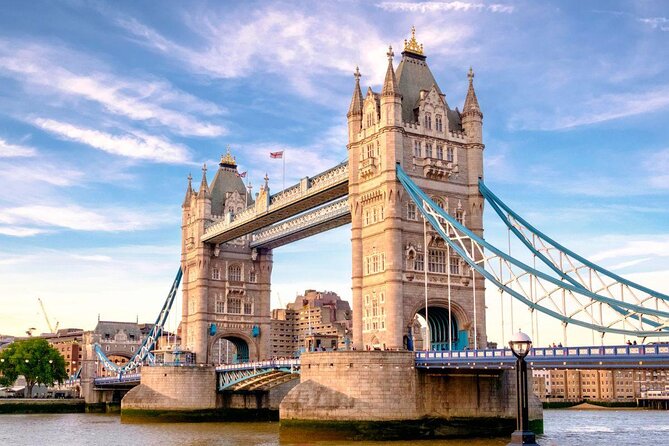
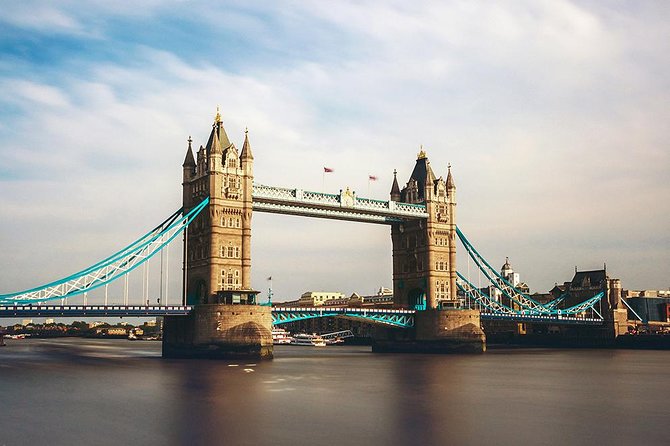
The tour then reaches Tower Bridge, where you get panoramic views of the Thames and the bridge itself. This is another famous subject, and that brings the same trade-off as St Paul’s. You are not being promised an undiscovered landmark. You are being shown how to photograph a well-known one with more care.
The route’s stated stop time is about 10 minutes. Weather matters here. The tour requires good conditions, and river views are naturally more dependent on the sky and light than indoor attractions are. If you book, choose clothing and footwear suited to an outdoor walk and be prepared for changing conditions.
Finishing at Tate Modern’s former power station
The tour ends at Tate Modern, housed in the former Bankside Power Station. The building was designed by Sir Giles Gilbert Scott, who also designed Battersea Power Station. Its large brick form dominates this part of the South Bank and gives you a final architectural subject with a very different character from the City churches.
You have about 10 minutes at the end. The focus is on the exterior and on photographing the building rather than on an included visit to the gallery’s interior. Tate Modern is Britain’s national gallery of international modern art, but no museum admission is included in the tour details.
This ending works well for the route. You begin with a church built over much older religious remains and finish with a converted industrial building devoted to modern art. Between them, you photograph finance, worship, war memorials, bridges, and the river. That range gives the walk a clear sense of place.
If you want to continue your day, Tate Modern is also a practical finishing point for independent sightseeing. The tour itself ends there, so any gallery visit would be separate.
What the photography coaching is really worth
The price is $71.63 per person. For a two-hour experience, that is not a bargain if you only want a guided sightseeing walk. You are paying for the photographer’s attention and for a structured way to practice, not for entry to attractions.
The value improves if you want to learn. The most useful feedback describes an instructor who supported different ability levels, explained camera techniques, and helped people experiment after relying too much on automatic settings. Another account specifically praises Richard for helping people get ready before setting off and for offering friendly, practical guidance during the walk.
That makes the tour more useful than a standard landmark walk for someone who owns a camera but does not use it with confidence. It can also suit a beginner using a camera phone, since composition and viewpoint matter regardless of equipment.
There is a limit to what two hours can cover. You will not receive a full photography course, and you cannot expect detailed editing instruction or a finished portfolio. The tour gives you a concentrated practice session with London as your subject.
The maximum group size is 18. That is not a private lesson, but it is small enough to make questions possible. Group ability may vary, too. The available feedback describes a mix of ages and skill levels, which can be a positive if you like a relaxed atmosphere, but it may mean the guide has to divide attention between beginners and experienced photographers.
Who should book this London photo walk?
I would recommend it most strongly to three kinds of people:
- You have a camera or camera phone and want specific guidance while using it.
- You are visiting London for the first time and want history tied to a practical activity.
- You live or work in London and want to see familiar buildings from a fresh angle.
It is also a good gift. One person used it as a present and found that the walk worked well despite already knowing the area near work. That says something useful about the experience: you do not need to be new to London to get value from it.
You should be comfortable walking outdoors for about two hours. The tour is near public transport, service animals are allowed, and most people can take part. The minimum age is 18. Children may attend only with an adult, and both need paid tickets.
The experience is not the best choice if you want rare, secret locations only. Most of the route uses major London sights. The creative benefit comes from photographing those places with more thought, not from avoiding well-known landmarks altogether.
Practical details before you pay
The meeting point is IMPRINT Church London, St Mary Woolnoth, at 10 to 13 Lombard Street, London EC3V 9AN. The tour finishes at Tate Modern, Bankside, London SE1 9TG.
A mobile ticket is provided, and booking confirmation arrives at the time of booking. Bring a camera or camera phone, since the experience is built around taking photographs. If you use a dedicated camera, bring the equipment you already understand rather than carrying more gear than you can comfortably manage.
The tour is non-refundable and cannot be changed for any reason after booking. If poor weather causes cancellation, you are offered another date or a full refund. The same applies if the minimum number of participants is not reached, with the option of another date or experience.
The overall rating is 4.5 from 10 ratings, with 90 percent recommending it. That is encouraging, but the small number of ratings means you should pay attention to the fit. The strongest praise centers on the guide’s friendly teaching, useful camera tips, and ability to work with mixed experience levels. The main criticism concerns expectations about unusual views and group size.
Should you book the History of London Photography Tour?
Book it if you want to learn while sightseeing. The route gives you a solid sample of central London, and the photographer guide adds practical help that you would not get from a normal walking tour.
I would be especially comfortable recommending it to beginners, casual SLR users who want to stop relying on automatic settings, and London residents who have photographed the famous sights many times but not with a clear plan.
Think twice if you want a quiet private lesson, a large amount of time at each landmark, or locations far from the usual tourist circuit. At $71.63, the tour earns its price through instruction, not admission tickets or exclusive access. Bring the right expectations, your camera, and clothing for the weather, and you should leave with both new photographs and a better sense of how to make them.
FAQ
How long does the History of London Photography Tour last?
The tour lasts approximately two hours.
How much does the tour cost?
The price is $71.63 per person.
Where does the tour start?
It starts at IMPRINT Church London, St Mary Woolnoth, 10 to 13 Lombard Street, London EC3V 9AN, UK.
Where does the tour end?
The tour ends at Tate Modern, Bankside, London SE1 9TG, UK.
Do I need to bring a camera?
Yes. You need a camera or camera phone to get the most from the experience.
Who leads the tour?
A professional photographer leads the tour. Richard is identified as a guide associated with the experience.
What sights are included?
Stops include St Mary Woolnoth, the Royal Exchange, the Bank of England, Guildhall, St Mary-le-Bow, St Paul’s Cathedral, the National Firefighters Memorial, Millennium Bridge, Tower Bridge, and Tate Modern.
What is the maximum group size?
The tour accepts a maximum of 18 participants.
What happens if bad weather cancels the tour?
You are offered a different date or a full refund if poor weather causes cancellation. A different date, experience, or full refund is also offered if the minimum number of participants is not reached.
More Heritage Tours in London
- London: Private Landmark Tour with Professional Photographer
★ 4.7 · 91 reviews - Private Landmark Photoshoot
★ 5.0 · 27 reviews - Iconic London Landmark Photography City Tour
★ 4.5 · 3 reviews - Private Tour: Historic London Photography Tour
★ 4.5 · 2 reviews
Just added around London
- Wildlife Photography Workshop in Richmond Park in London★ 4.5 · 5 reviews
- Private Tour: Photography Walking Tour from Trafalgar Square to Covent Garden★ 5.0 · 5 reviews
- Street Photography Workshops in London★ 5.0 · 6 reviews
- Shoreditch Street Art Private Photography Tour including Brick Lane★ 5.0 · 5 reviews
- South Bank Photography Tour – Small Group★ 5.0 · 2 reviews
- Ultimate introduction to photography in Central London★ 5.0 · 19 reviews
- Private Landmark Photoshoot★ 5.0 · 27 reviews
- PRIVATE PHOTOSHOOT in London★ 5.0 · 6 reviews
Photography Tours, compared.

Rhodes: E-bike Highlights Sunset or Morning Photo Tour
Read our review →
Browse the lists this tour appears in