REVIEW · LONDON
London Photography Tour – Private Tour
Central London becomes your classroom on this private photography walk, with a professional fine art photographer helping you turn famous sights into stronger pictures. You’ll work on composition, light, aperture, focus, and shutter speed while moving from Trafalgar Square to the London Eye. I especially like the one-to-one coaching and the chance to photograph both grand landmarks and small details such as phone boxes, statues, buses, and street scenes. The main drawback is the price: at $336.40 per person, it makes the most sense for a small private group that truly wants photography instruction, not just a guided sightseeing walk.
I also like that you use your own equipment, including a smartphone, and review your progress during the outing. Previous guests have praised Lou for her patient, practical teaching and for helping both beginners and experienced photographers feel more confident. Four hours on foot is a serious stretch, though, so wear comfortable shoes and expect the tour to operate in rain or shine.
Key points to know before booking
- Private tuition with a professional fine art photographer: You get advice aimed at your camera, your skill level, and the kinds of pictures you want to make.
- A useful central London route: The walk links Trafalgar Square, Leicester Square, Piccadilly Circus, Whitehall, Westminster Abbey, Parliament Square, and the London Eye.
- Good for cameras and phones: You can bring an SLR, mirrorless camera, compact camera, or smartphone.
- Practical skills, not just sightseeing: Expect help with aperture, depth of field, shutter speed, white balance, focusing, lens choice, and composition.
- A private pace: Only your own group takes part, with a short break to review photographs and adjust your approach.
- A long walk with no food included: Refreshments and lunch are extra, and you need a fully charged battery plus spare memory cards.
Why this private photo walk is different
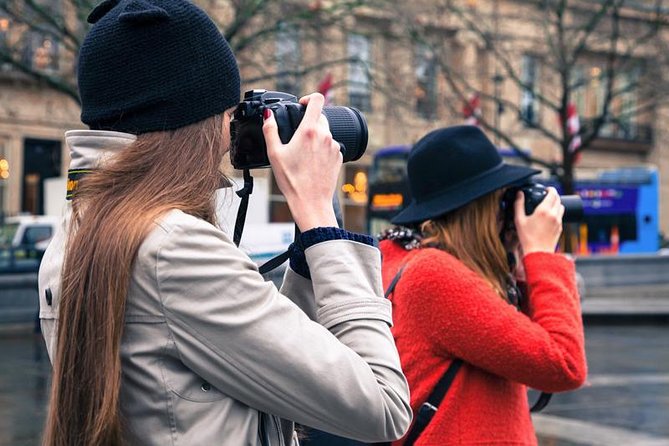
Many London sightseeing tours ask you to look, listen, and keep moving. This one asks you to stop and make decisions. Should you use a wide view to show Trafalgar Square’s scale? Would a tighter frame make a statue more striking? Is the light helping your subject or flattening it? Those are the questions that turn a holiday snapshot into a photograph with purpose.
Your guide works with the equipment you already own. That matters because advice is far more useful when it applies to your actual camera or phone. The teaching covers basic controls for beginners, but it also gives more experienced photographers a chance to sharpen composition, exposure, focus, and perspective.
The tour is private, so you are not tied to the needs of a large group. If you want extra help with portraits, architecture, street details, or camera settings, you can ask as you go. Lou has been singled out for being encouraging, clear, and skilled at explaining camera functions, and one family used the tour successfully with a 17-year-old photographer carrying an SLR.
More Photography Tours in London
- Private Tour: Night Photography Tour in London
★ 5.0 · 48 reviews - Private Night Photography Tour in London
★ 5.0 · 29 reviews - Photography Tour walking the back streets of London’s West End (3 hours)
★ 5.0 · 24 reviews
Trafalgar Square: start with composition and light
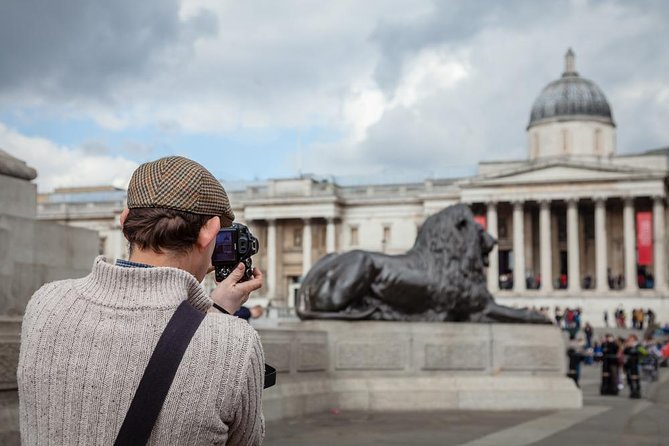
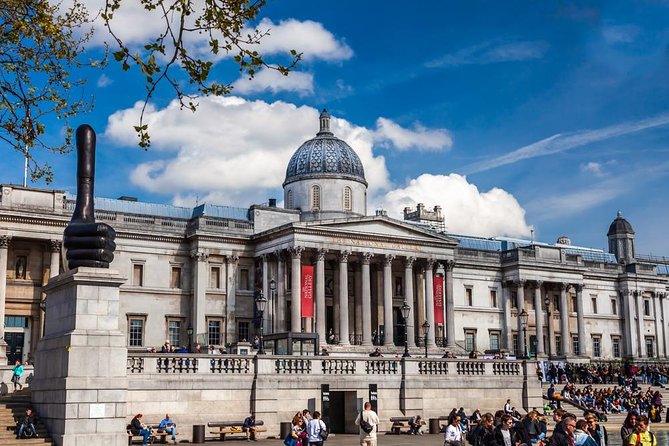
The tour begins near Charing Cross and heads to Trafalgar Square, a strong place to learn because it offers many subjects in one compact setting. You can photograph the Landseer lions, fountains, statues, the National Gallery, street performers, pavement art, and the long view toward Whitehall.
This is where the technical work starts. You learn how aperture affects depth of field, how light changes the mood of a picture, and how framing can give a familiar place more impact. The square also gives you a useful lesson in scale. A wide composition can show the open space and surrounding buildings, while a tighter frame can make a lion, fountain, or performer the main subject.
The listed stop lasts about 35 minutes. That is enough time for a quick introduction and several exercises, though you should not expect to photograph every corner in detail. Crowds and street activity can change the feel of the square, which is part of the appeal but can also make clean compositions harder.
The National Gallery: use architecture as a subject
The National Gallery is photographed from the outside during a short, 15-minute stop. The focus is less on entering the museum and more on using the building’s lines, angles, textures, and scale.
Your photographer can help you test different angles of view, focus points, and depth-of-field settings. This is useful if your pictures often look flat or if you tend to photograph buildings straight on. A small change in your position can alter the relationship between the facade, the square, and the people around you.
Because the stop is brief, think of it as a focused exercise rather than a full architectural photography session. Admission is not needed for this part, and the tour keeps moving through the West End.
Leicester Square: statues, gardens, and portrait practice
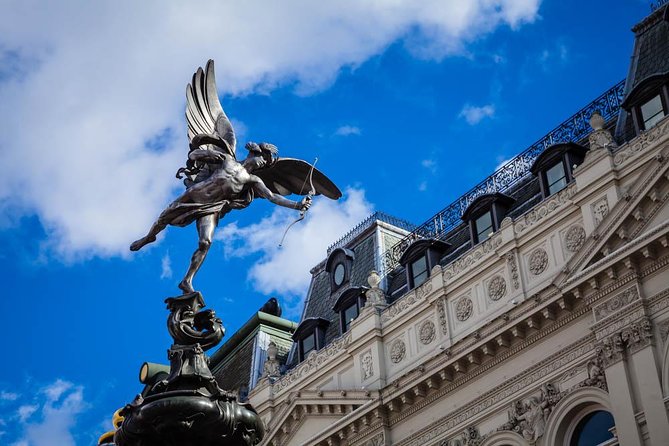
From Trafalgar Square, you walk to Leicester Square at a relaxed pace. The gardens, fountains, William Shakespeare statue, and Charlie Chaplin statue offer different ways to practice framing and portrait-style composition.
You work with aperture and depth of field here, including how to isolate a subject from its surroundings. The statues are still subjects, but treating them like portraits helps you think about expression, angle, background, and light. You can also try photographing the gardens from more than one viewpoint rather than accepting the first obvious frame.
This stop runs about 25 minutes. Leicester Square is known for film premieres and red-carpet events, but the photography value is in its mix of formal statues, planted areas, public space, and changing activity. If you want a quiet, carefully controlled shoot, this may feel busy. If you want practice finding order in a public place, it is useful.
More Photography Tours in the UK
- London: Iconic Sights Photo Walking Tour
★ 4.9 · 12 reviews - Iconic London Photo Walking Tour
★ 4.6 · 11 reviews - A Professional Photo Walk Experience in London
★ 5.0 · 4 reviews - London Photo Tour with a Private Photographer
★ 5.0 · 3 reviews
Piccadilly Circus: small details and camera handling
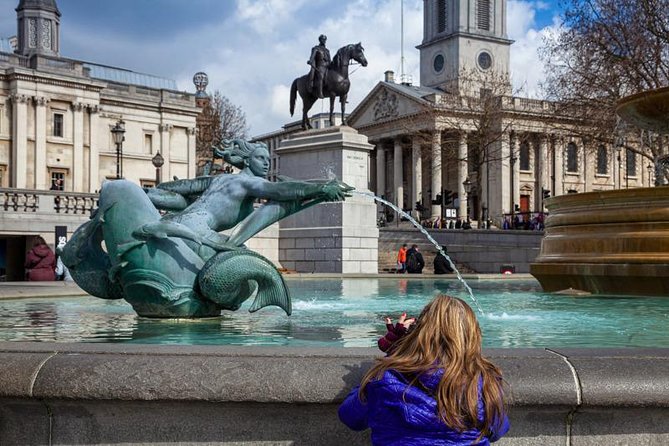
The route continues through side streets and small shops toward Piccadilly Circus. Along the way, you might photograph red telephone boxes, London buses, shopfronts, street details, and the Statue of Eros. Regent Street banners add height and color to the view.
This is a good section for learning to see beyond the headline sight. Piccadilly Circus is famous, but your best photograph may be a detail in a side street or an unusual angle on a familiar object. Your guide covers camera handling, composition, light, white balance, and lens choice.
The stop lasts about 45 minutes and includes a short working break to look at your progress. That review is one of the most useful parts of the experience. You can see which settings produced sharp images, which compositions feel crowded, and what to try during the second half.
No particular camera brand is required. The experience is designed for all digital cameras and smartphones, so you do not need expensive equipment to take part. Still, bring the device you know how to use. A private lesson is most helpful when you can spend time making pictures rather than trying to learn unfamiliar controls from scratch.
Whitehall and Horse Guards Parade: freeze movement
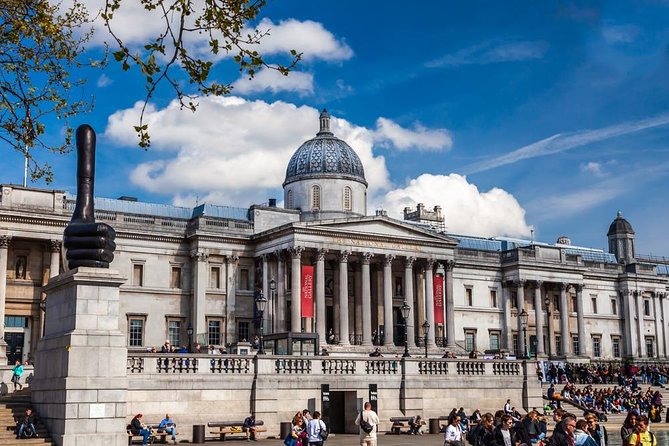
From Piccadilly Circus, the walk continues toward Admiralty Arch, Horse Guards Parade, and Whitehall. This section adds people, uniforms, horses, monuments, and government buildings to the mix.
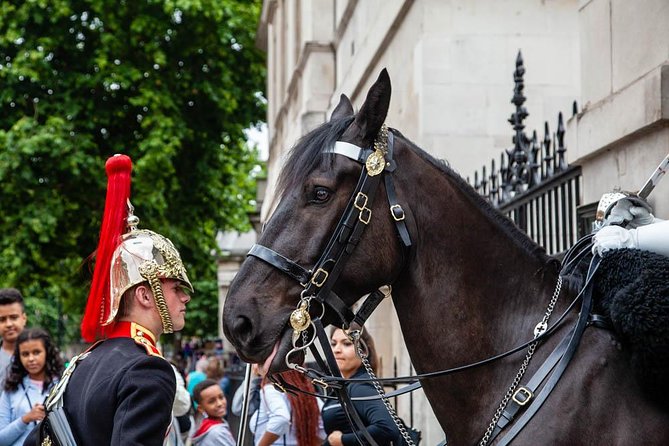
Mounted sentries and horse guards give you a chance to work on action and portrait settings. Your guide covers shutter speed for freezing movement, aperture values for portraits, focusing methods, and fill flash. You can also think about how to photograph a uniformed guard with enough surrounding space to show the setting.
The area includes the Cabinet War Rooms, statues honoring the Women of the Second World War, and a notable Westminster Tube sign. These details help you build a varied set of London pictures instead of collecting only postcard views.
The stop is scheduled for about 40 minutes. It is worth remembering that guards and horses are working parts of a public setting, not posed models. Listen to your guide about position and timing, and keep your camera work respectful.
Big Ben and Parliament Square: classic London, better framing
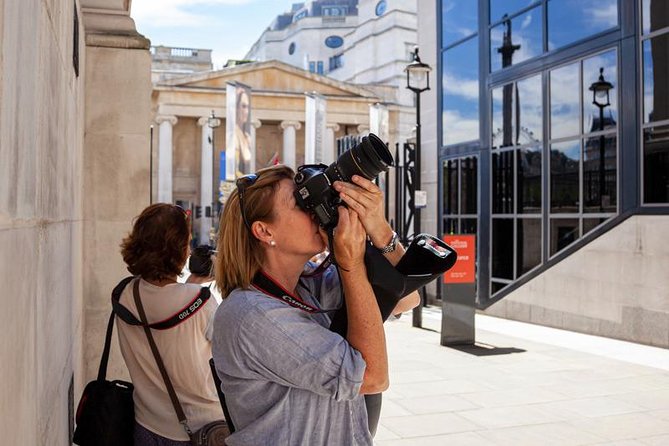
At Westminster, you photograph Big Ben, the Houses of Parliament, and a red telephone box. The subjects are familiar, but that makes technique especially important. Millions of people have taken the same basic picture. Your guide helps you find a cleaner frame, use the available light, and decide how much of the surrounding setting belongs in the shot.
The Big Ben stop is listed at about 15 minutes, followed by roughly 30 minutes in Parliament Square. The square gives you statues of Winston Churchill, Mahatma Gandhi, and Nelson Mandela, with the Houses of Parliament behind them.
This is a useful place to practice layers in a photograph. A statue can be your foreground subject, while the buildings provide context behind it. You can also compare a wide view with a tighter portrait and see how lens choice changes the feel of the image.
The route does not include entry into the Houses of Parliament or Westminster Abbey. You photograph the exteriors, which keeps the tour focused on walking, outdoor light, and practical camera work.
Westminster Abbey: scale and architectural detail
Westminster Abbey is another short outdoor stop, about 15 minutes. Its importance comes through in the building’s size, detail, and connection to royal weddings, including the wedding of Prince William and Kate.
The photography lesson centers on scale, composition, framing, lens selection, zoom, and creative aperture settings. You may work out how to show the full structure, then move closer to isolate an architectural detail. That comparison helps you understand why one lens or focal length may work better than another.
This stop is best treated as a quick architectural exercise. If you want to tour the abbey’s interior, this experience will not provide that. If your aim is to leave with a strong exterior photograph and better control of your camera, the stop fits the tour well.
The London Eye: finish with river views
The final major stop is across the river from the London Eye. At 443 feet, the wheel gives you a clear lesson in scale and proportion. Your guide can help you frame it against the river, nearby buildings, and passing activity rather than photographing it as an isolated object.
You work on light, depth of field, shutter speed, focus, lens choice, and composition. River views can also give you a chance to experiment with reflections and movement, though the exact conditions will depend on the weather and time of day.
The planned time here is about 20 minutes. It is a fitting finish because you can compare the techniques used throughout the walk: wide compositions for scale, tight frames for detail, faster shutter speeds for movement, and careful focusing for distant subjects.
The advertised route ends at Victoria Embankment. From there, you can continue sightseeing on your own, and the nearest rail and Tube connections are around Charing Cross at the starting area. The tour itself does not include refreshments or lunch, so plan a snack before or after the walk.
What you will actually learn
The instruction is broad but practical. Depending on your camera and interests, you may work on:
- Aperture and depth of field
- Shutter speed for action
- Focusing techniques
- Exposure and light
- White balance
- Lens choice and zoom
- Framing and composition
- Angles of view
- Fill flash
- General camera handling
This range suits a beginner who wants to understand manual controls, but it can also help an experienced photographer who wants outside feedback. The most useful benefit is the chance to apply each setting immediately. You do not just hear an explanation of shutter speed, then wait until the next day to test it. You photograph horses, statues, buildings, buses, and river views as the lesson develops.
The short photograph review is also important. You can identify what is working and adjust before reaching the final stops. One participant returned home feeling more confident about composition, exposure, and sharpness, which is the kind of lasting result worth seeking from a photography lesson.
Is $336.40 per person good value?
The price is high for a four-hour walk, especially if you compare it with a standard group sightseeing tour. But this is not priced as ordinary sightseeing. You are paying for a private guide, photography tuition, equipment-specific help, route planning, and time spent reviewing your work.
Value improves when two or more people in your party are genuinely interested in photography. The private format lets you share the guide without adding unrelated participants, and group discounts may be available. It is harder to justify the price if one person wants a camera lesson while everyone else mainly wants a quick tour of the sights.
You also need to factor in what is not included. Food and drinks are extra, and you must bring your own camera or phone, battery, and memory cards. The tour supplies instruction, not photographs taken for you.
Who should book this London photography tour?
I would recommend it to beginners who want patient help with their own equipment, couples who want a private creative activity, families with a young photographer, and experienced camera users who want a second set of eyes on their work.
It is particularly well suited to someone who wants more than a list of landmarks. You will photograph the classic sights, but the real point is learning how to make decisions at each location.
I would be more cautious if you dislike walking, need a fully indoor activity, or want to visit the interiors of the National Gallery, Westminster Abbey, or Parliament. The tour runs in all weather, and four hours on foot can feel long. Wear suitable clothing and comfortable shoes.
Should you book it?
Book this tour if you want to finish your London visit with stronger camera skills, not just a folder of familiar snapshots. The private format, hands-on coaching, and well-chosen route give you a useful mix of instruction and sightseeing. Lou has received especially strong praise for clear, encouraging guidance, though you should confirm your guide when booking if that matters to you.
Skip it if your main aim is fast sightseeing or if $336.40 per person feels too steep for a walking tour. For the right small group, though, this is a practical way to see central London while learning to photograph it with more thought and control.
FAQ
How long does the London Photography Tour last?
The tour lasts approximately four hours.
Where does the tour start?
It starts at Charing Cross, London WC2N 5DP. Charing Cross is the nearest rail and Tube station listed for the meeting area.
Where does the tour end?
The tour ends at Victoria Embankment in London.
Is this a private tour?
Yes. Only your own group takes part in the activity.
What type of camera can I bring?
You can bring any type of digital camera, including an SLR, mirrorless camera, compact camera, or smartphone.
Is the tour suitable for beginners?
Yes. The tour is suitable for all skill levels and includes guidance on camera handling, composition, light, focusing, aperture, and shutter speed.
What should I bring?
Bring your camera or smartphone, a fully charged battery, and additional memory cards for the photographs you take. Dress appropriately for the weather.
What happens if I need to cancel?
You can receive a full refund if you cancel at least 24 hours before the local start time. Cancellations or changes made less than 24 hours before the start time are not accepted for a refund.
More Private Photoshoots in the UK
- London: Private travel vacation photoshoot -Romantic Special
★ 4.7 · 50 reviews - Professional Private Couple Photoshoot
★ 5.0 · 35 reviews - London: Private Couples Photography Session with Landmarks
★ 5.0 · 16 reviews - London: Private Photo Session in Westminster
★ 4.9 · 16 reviews
More Private Photoshoots in London
- London: Private Photoshoot with Video Clip Option
★ 4.8 · 182 reviews - Private landmarks photoshoot for families and couples
★ 5.0 · 92 reviews - London: Private Landmark Tour with Professional Photographer
★ 4.7 · 91 reviews - Professional Private Photoshoot in London
★ 5.0 · 63 reviews
Just added around London
- London 1- or 2-Hour Professional Photo Shoot★ 4.9 · 6 reviews
- London: West End Photography Walking Tour with Guide★ 5.0 · 2 reviews
- London: Private Photo Session at Iconic Landmarks★ 5.0 · 6 reviews
- London: A Unique Photoshoot Experience at Famous Sites★ 4.6 · 22 reviews
- London: Private travel vacation photoshoot -Romantic Special★ 4.7 · 50 reviews
- London: Private Couples Photography Session with Landmarks★ 5.0 · 16 reviews
- London Photo Tour with a Private Photographer★ 5.0 · 3 reviews
- London 60min PRIVATE Personal Vacation & Travel Photographer★ 5.0 · 5 reviews
Private Photoshoots, compared.
️ Bali Instagram Tour: The Most Famous Spots (Private & All-Inclusive)
Read our review →
️ Phuket Private Instagram Tour: All-Inclusive
Read our review →
NYC Professional Photoshoot and Walking Tour with Private Guide
Read our review →
️ Nusa Penida Instagram Tour: The Most Famous Spots (Private All-Inclusive)
Read our review →