
REVIEW · LONDON
East End London Instagrammable Street Art and Graffiti Tour
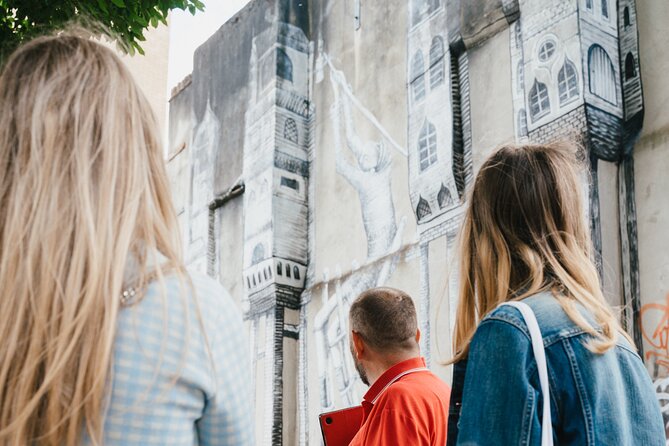
East London’s street art is not displayed behind glass or arranged in neat museum rooms. It spreads across backyards, shop shutters, old brick walls, narrow yards, and whole sides of buildings. This tour takes you from Whitechapel through Brick Lane and Shoreditch, where a quick turn into an alley can reveal a giant bird, a ribbon-like soldier, or an old Banksy protected behind glass.
I like the way the walk mixes famous names with working street artists, so you see more than the usual Banksy checklist. I also like the chance to make your own street art, which gives the tour a hands-on finish. The main consideration is pace: 17 stops in about two hours means some visits are brief, and the art can change between visits.
Key points at a glance
- Banksy and beyond: See protected Banksy pieces alongside work by Stik, ROA, Martin Ron, Ben Eine, Thierry Noir, and others.
- A changing open-air gallery: Allen’s Gardens and Brick Lane can look different from one week to the next as new work covers older pieces.
- Stories behind the walls: Learn about immigration, local communities, graffiti writers, street-art styles, and East London’s graffiti wars.
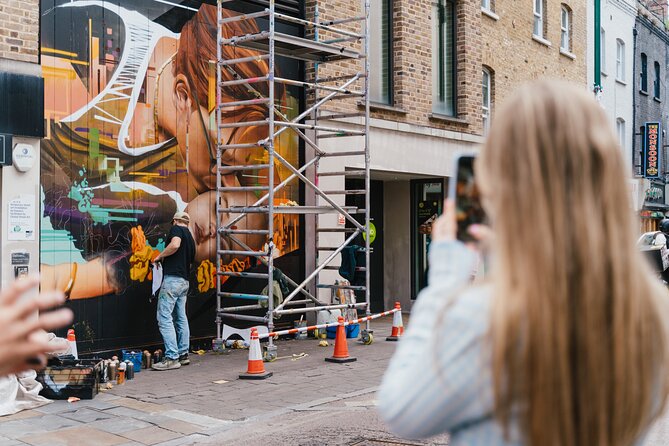
- Photo-friendly route: The walk includes giant murals, unusual doors, colourful portraits, bold lettering, and plenty of places to frame a picture.
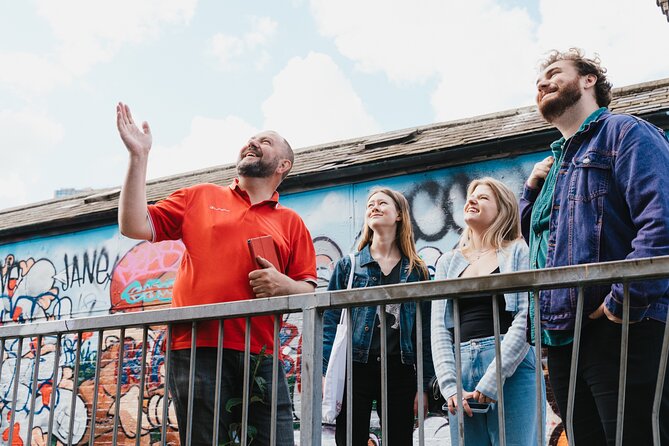
- Small-group format: The maximum group size is 20, which should make it easier to hear the guide in narrow streets and yards.
- Easy city finish: The walk begins near Aldgate East and ends within walking distance of Liverpool Street Station.
From Whitechapel to Brick Lane, the tour finds the art between the sights
The meeting point is at 80 Whitechapel High Street, close to public transport. The start time is 11:00 am, and the walk finishes near Liverpool Street Station. That makes it easy to fit into a day of sightseeing, though you should allow a little extra time after the final stop because the exact ending point may change with the art.
You begin in Heneage Street, where two large works are tucked into small backyards. Phlegm’s piece features his familiar long, thin figures moving on stilts above layers of tags. Across the street is a work by FanakaPan, known for silver balloon images based on an animated classic. These are good opening stops because they teach you to look upward and sideways. The art is not always at eye level, and the best details may be easy to miss from the main road.
Brick Lane brings a different scale. On doors by Dan Kitchener and Perspicere, the guide encourages you to view the work from a distance and then step closer. The pieces are not huge, but their technical detail rewards a slow look. This is one of the tour’s useful lessons: street art is not only about a wall-sized mural. Sometimes the strongest work is on a door or a narrow surface.
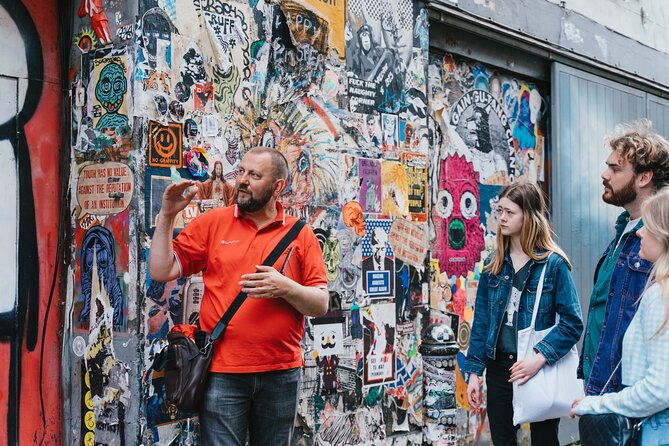
At The Seven Stars, the setting becomes rougher and more enclosed. Stickers cover the yard, showing how small pieces can become a complete art form of their own. You may also add a little art yourself, making this stop more active than a standard photo opportunity. The yard is narrow and dirty, so sensible footwear is useful.
More Instagram Spot Tours in the UK
- London: East End Instagrammable Street Art & Graffiti Tour
★ 4.9 · 22 reviews - London through the lens: Iconic photo spots, hidden gems & food.
★ 5.0 · 20 reviews - London: Instagram Photos Black Cab Tour with Hotel Pick Up
★ 5.0 · 7 reviews
Community, migration, and the meaning behind a simple figure
Princelet Street provides one of the tour’s more thoughtful stops. A work by Stik honours the Muslim community and its long connection with the area. Its simple figure and strong colours make it easy to read, but the story behind it gives the piece greater weight.
The work has been defaced and repainted several times. That repeated restoration matters. It shows how a piece of street art can become part of a neighbourhood’s identity, rather than remaining a temporary decoration. If you are interested in the social side of public art, this is one of the stops worth lingering over.
On Hanbury Street, a large bird by ROA draws you down a side street. Once there, you find much more: stickers, black-and-white slogans by Wrdsmth, small colourful pieces, and a huge upside-down figure by Martin Ron. The scale is impressive, but the clever part is how the figure uses the building’s existing features.
This is also a good place to remember that street art changes. Some smaller works may be different by the time you arrive. The two larger pieces have lasted for many years, which is a long life in graffiti terms, but nothing in this setting is guaranteed to remain forever.
Broccoli, graffiti writers, and the art of hard-to-read letters
At Dray Walk, look for broccoli. Adrian Boswell began placing broccoli images around Brick Lane, and the joke grew into a local visual theme. Some versions look realistic, while others appear in bright, unexpected colours. The artist now has a gallery and sells framed broccoli, a funny example of how a repeated street image can turn into a recognised artistic signature.
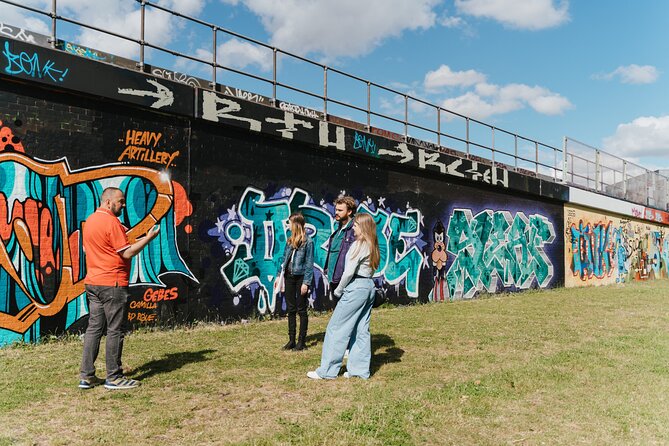
Allen’s Gardens shifts attention from individual artists to graffiti writing. The area is surrounded by walls covered in large pieces, many of which change every few days. The guide explains the difference between graffiti writers, who focus mainly on letters, and artists who create figures, scenes, or stencils.
The lettering may be difficult, even impossible, to read. That is part of the challenge. The artists are using colour, shape, and movement to make words work almost like abstract art. Take photos here if you see something you like, since a new layer may cover it soon.
As you leave the park via Buxton Street, look up for the number 5. This short stop focuses on collaboration and recognisable artist styles. It is a useful reminder that many walls are built by several artists, each contributing a section with a different colour range or technique.
Ebor Street brings polished murals and bold lettering
The route then moves from the older, rougher feel of Brick Lane toward the more modern side of Shoreditch. Ebor Street has large painted adverts made by graffiti artists, along with smaller works such as Neon’s pink portraits. Her faces seem to be made from light sprays of paint, with the colour landing in just the right places.
This part of the route is particularly good for photography. You get broad walls for full-frame shots, but also smaller details for close-ups. The changing mix of adverts, portraits, tags, and murals gives the street a less fixed appearance than a conventional gallery.
A second stop on Ebor Street focuses on Ben Eine. His large letters are direct and easy to read, unlike the deliberately obscure writing at Allen’s Gardens. His alphabet keeps a consistent look, but the fonts change from piece to piece. Some are rounded and decorative, while others are sharp or square.
That contrast is one of the tour’s strengths. You are not simply collecting names. You are learning to spot different visual languages: complex letter forms, clean block lettering, soft spray portraits, stencils, and painted figures.
More Instagram Spot Tours in London:
- Bali: Full-Day Instagram Highlights Tour
★ 4.8 · 7,817 reviews - ️ Bali Instagram Tour: The Most Famous Spots (Private & All-Inclusive)
★ 5.0 · 2,857 reviews - Dubai: Instagrammable Yacht Tour with Drinks & Ain/JBR Views
★ 4.7 · 1,494 reviews - Murals of Nashville Instagram Tour by Golf Cart
★ 5.0 · 950 reviews
Banksy, protected walls, and the question of ownership
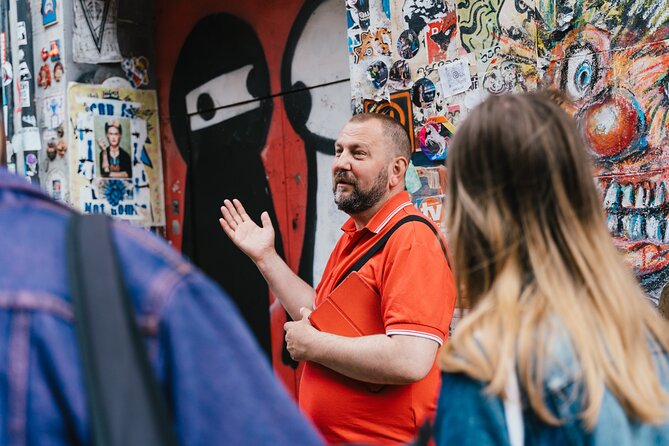
No East London street-art walk would feel complete without Banksy. On Rivington Street, the guide leads you to an enclosed area where older Banksy works appear beside pieces by less famous artists.
The Banksy works are protected by glass panels. That gives you a clear view, but it also raises a fair question: when does protecting street art change the nature of the work? The tour invites discussion about the art market, public space, fame, and personal taste. You do not have to agree with every decision. The point is to look closely and think about what happens when unofficial public art becomes valuable.
Nearby, an apparently incomplete soldier by Otto Schade becomes whole when you stand in the right place. Schade’s work is recognisable by ribbon-like lines that create figures with energy and movement. This stop rewards careful positioning, so listen to the guide before taking your photo.
Further along Rivington Street, you encounter the colourful heads of Thierry Noir. The French artist is closely associated with his work on the Berlin Wall in the 1980s, but his cheerful characters have also appeared in London. Their bright faces offer a welcome change after the darker, more complex imagery elsewhere on the route.
A Banksy wall fragment and Shakespeare on a bench
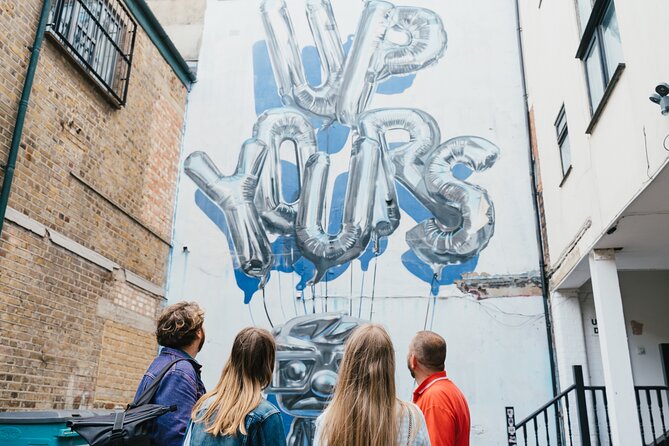
At art’otel London Hoxton, part of a wall painted by Banksy was removed from its original location and installed outside the hotel. It is now available for anyone passing by to see and judge. The setting is newer and more polished than the lanes around Brick Lane, which makes the piece’s relocation especially noticeable.
This is another useful moment for considering the uneasy relationship between street art and property. Removing a wall protects a work, but it also takes it away from the place and context that helped give it meaning. The guide uses the stop to encourage conversation rather than handing you one approved opinion.
Hewett Street offers a clever change of subject. A statue of William Shakespeare sits on a bench marking the former Curtain Theatre site. You can sit beside him for a photograph, then look across to a graffiti image of Romeo and Juliet.
The pairing connects East London’s theatrical past with its current street-art culture. It also stops the tour from becoming a parade of spray paint alone. The area’s older stories remain visible, even when the surrounding walls are covered in modern work.
At New Inn Broadway, one large building functions as a shared canvas. Several artists use different colours, styles, and subjects, including a small policeman. Together, the works form a large piece of graffiti wallpaper. It is a good final example of collaboration, even if you prefer some sections more than others.
The final walk toward Liverpool Street
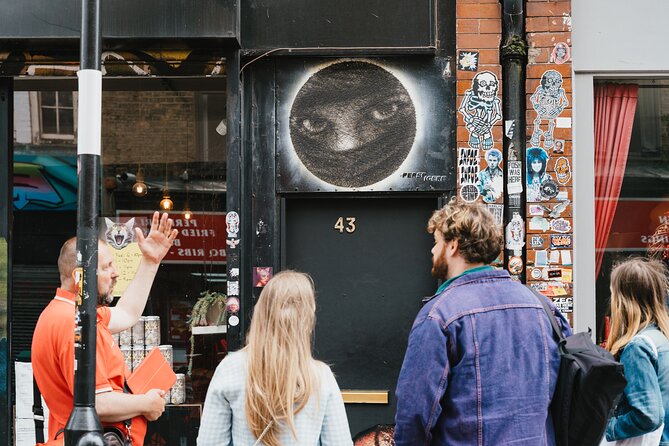
The tour ends near Shoreditch High Street as the old brick streets give way to the glass and steel buildings of the City. Before finishing, you hear one last account of the local graffiti wars and the art that came out of them.
That change in scenery gives the route a clear shape. You start near Whitechapel, move through the lanes and yards of Brick Lane, pass through Shoreditch’s modern art zone, and finish close to the business district. The walk is not simply a collection of murals. It shows how the area changes from one street to the next.
The stated duration is about two hours, with most stops lasting five to ten minutes. Since there are many stops, the guide has to keep things moving. You will get an explanation at each location, but this is not the format for standing quietly in front of one mural for half an hour.
Is $49 a fair price?
At $49 per person, the value depends on how much context you want. You can walk through Brick Lane and Shoreditch on your own, and you will certainly see plenty of graffiti without paying for a tour. What you cannot easily recreate is the route’s sequence, the artist recognition, the stories behind particular works, and the chance to notice pieces tucked away from the main streets.
The tour also includes the street-art activity, which adds something beyond a standard walking tour. A maximum of 20 people keeps the group manageable, though a full group may still feel crowded in narrow yards.
The strongest value comes if you are new to street art or want to understand what you are seeing. If you already know the artists and have spent days photographing East London walls, the pace may feel quick and some stops familiar. The free cancellation policy allows you to cancel up to 24 hours before the start for a full refund, which gives you some flexibility when planning.
Who should book this East London art walk?
I would choose this tour if you enjoy photography, contemporary art, local neighbourhood stories, or seeing a side of London that is not built around major monuments. It also suits first-time visitors who want an easy introduction to Brick Lane and Shoreditch without planning a route themselves.
Families and mixed-age groups may like the short stops and visual variety, although the narrow yards and rough surfaces call for comfortable shoes. Most people can take part, and service animals are allowed.
You should think twice if you dislike walking, prefer formal museums, or want guaranteed access to one specific Banksy work. Street art changes, and the exact end point can shift. The reward is the uncertainty: you see art in the places where it lives, not a fixed display that looks the same every day.
Should you book it?
Book this walk if you want a guided introduction to East London’s street-art culture, with Banksy, major murals, small stickers, community stories, and graffiti writing all in the same route. The mix of famous artists and lesser-known work is more useful than a simple hunt for Instagram backgrounds.
Skip it if you want a slow, highly specialised art lecture or prefer exploring at your own pace. For most visitors, though, the two-hour format is a practical way to make sense of Brick Lane and Shoreditch, especially when you want both good photos and the stories behind the walls.
FAQ
Where does the tour start?
The tour starts at 80 Whitechapel High Street, London E1 7QX, UK.
What time does the tour begin?
The scheduled start time is 11:00 am.
Where does the tour finish?
The tour finishes within walking distance of Liverpool Street Station. The exact end point can change depending on the street art route.
How long does the tour last?
The walk lasts approximately two hours.
What is included in the experience?
It includes a walking tour led by a local London guide and an opportunity to make your own street art.
Is Banksy included on the route?
Yes. The route includes older Banksy works on Rivington Street and a Banksy wall fragment displayed outside art’otel London Hoxton.
How large is the group?
The maximum group size is 20 people.
Can I cancel for a full refund?
Yes. You can cancel at least 24 hours before the experience start time for a full refund. Changes or cancellations made less than 24 hours before the start are not accepted for a refund.
More Street Art Tours in London
- Nashville: Street Art & Instagram Golf Cart Tour
★ 4.9 · 77 reviews - Lisbon: 2-Hour Street Art Photo Tour
★ 4.9 · 43 reviews
Just added around London
- London 1- or 2-Hour Professional Photo Shoot★ 4.9 · 6 reviews
- London: West End Photography Walking Tour with Guide★ 5.0 · 2 reviews
- London: Private Photo Session at Iconic Landmarks★ 5.0 · 6 reviews
- London: A Unique Photoshoot Experience at Famous Sites★ 4.6 · 22 reviews
- London: Private travel vacation photoshoot -Romantic Special★ 4.7 · 50 reviews
- London: Private Couples Photography Session with Landmarks★ 5.0 · 16 reviews
- London Photo Tour with a Private Photographer★ 5.0 · 3 reviews
- London 60min PRIVATE Personal Vacation & Travel Photographer★ 5.0 · 5 reviews
Instagram Spot Tours, compared.


️ Bali Instagram Tour: The Most Famous Spots (Private & All-Inclusive)
Read our review →
Murals of Nashville Instagram Tour by Golf Cart
Read our review →
Fansipan Cable, Cat Cat Village & Moana Instagram Tour
Read our review →

️ Phuket Private Instagram Tour: All-Inclusive
Read our review →

Browse the lists this tour appears in