REVIEW · LONDON
Private Night Photography Tour in London
London looks almost purpose-built for night photography. The London Eye glows beside the Thames, red buses leave bright trails, and Tower Bridge gives you strong lines, reflections, and color after dark. With professional photographer David, you learn by taking pictures, not by sitting through a lecture.
I like the way this tour welcomes both serious camera users and iPhone photographers. I also like the practical teaching: long exposures, creative zoom effects, multiple exposure settings, and low-light controls are explained at the exact moment you can use them. The main thing to consider is the price, about $164.52 per person, and the need for a tripod if you want the best long-exposure results.
Key points to know before you book
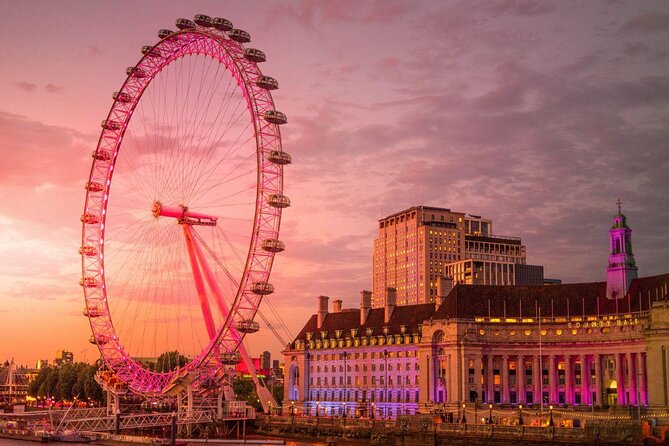
- London after dark: Photograph the London Eye, St Paul’s Cathedral, the City of London, and Tower Bridge.
- David’s personal instruction: Expect help with framing, camera settings, and creative night techniques.
- Any camera can work: Bring a DSLR, mirrorless camera, compact camera, or smartphone.
- Long exposures are central: A tripod gives you more freedom and sharper results.
- Private booking format: The activity is presented as private, though one session included three participants, so confirm the exact arrangement.
- Useful follow-up material: Your photography e-guidebook helps you keep practicing after the walk.
Why London at night makes a good photography classroom
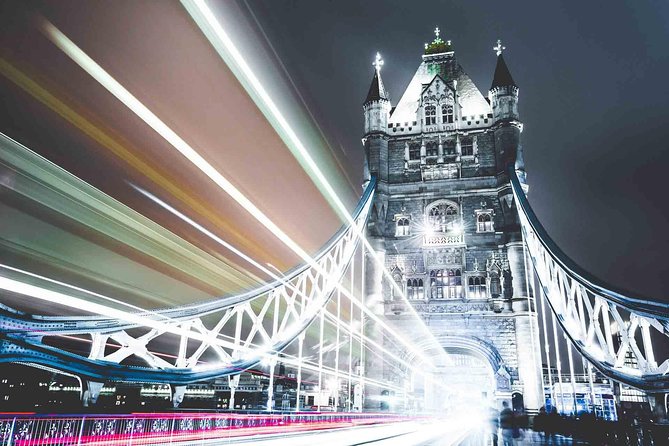
The best part of this experience is that London itself supplies the lesson. You do not need to search for a dramatic subject. Light moves across the river, boats blur into soft streaks, traffic creates ribbons of color, and famous buildings take on a different character once their daytime crowds thin out.
You also get a useful mix of subjects. Landmark photography teaches composition and perspective. Moving cars teach light trails. Boats on the Thames teach timing. Reflections teach you to look down as well as ahead. That variety makes the session more useful than a simple walk from one famous building to another.
David’s teaching style is hands-on. He can show you how a small change in exposure, focus, or framing affects the finished image, then give you time to try it yourself. If you use a Canon, Nikon, Sony, iPhone, or another familiar system, you can work with the equipment you already understand.
The experience is also suited to different skill levels. If you are new to photography, you can learn the basic controls and see how night settings work. If you already shoot regularly, you can focus on more creative options such as multiple exposures, zooming during a long exposure, and unusual viewpoints.
More Photography Tours in London
- Private Tour: Night Photography Tour in London
★ 5.0 · 48 reviews - Photography Tour walking the back streets of London’s West End (3 hours)
★ 5.0 · 24 reviews - London Photography Tour – Private Tour
★ 5.0 · 17 reviews
Starting at Caffè Nero near Westminster
The meeting point is Caffè Nero, Unit B, Portcullis House, 1-2 Bridge Street, London SW1A 2JH. This gives you a clear place to meet before heading toward the river and the first photography stop.
The exact order and pace may vary, but the supplied route includes the London Eye, St Paul’s Cathedral, the City of London, and Tower Bridge. The activity ends back at the meeting point, so you are not left trying to work out where the walk finishes.
The tour lasts about two and a half hours, while the experience description also refers to a three-hour night tour. Allow roughly that range when planning your evening. Night photography takes longer than ordinary sightseeing because each picture may require setup, adjustments, and several attempts.
You should arrive with your camera charged. One participant had a battery die during the session and switched to an iPhone, which still allowed the lesson to continue. That is a useful reminder to bring a charged phone as a backup, even if you plan to use a dedicated camera.
Stop one: the London Eye and the Thames
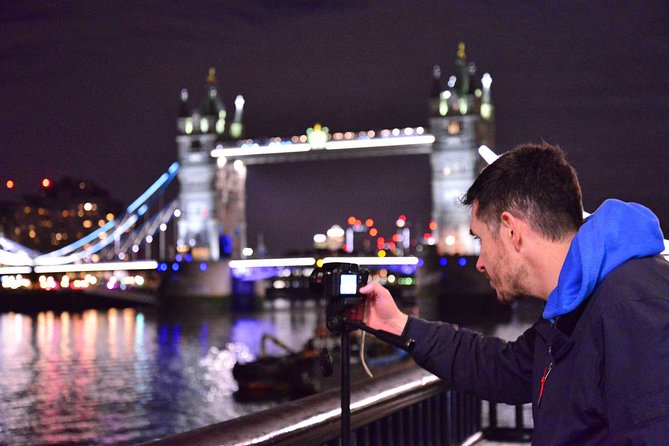
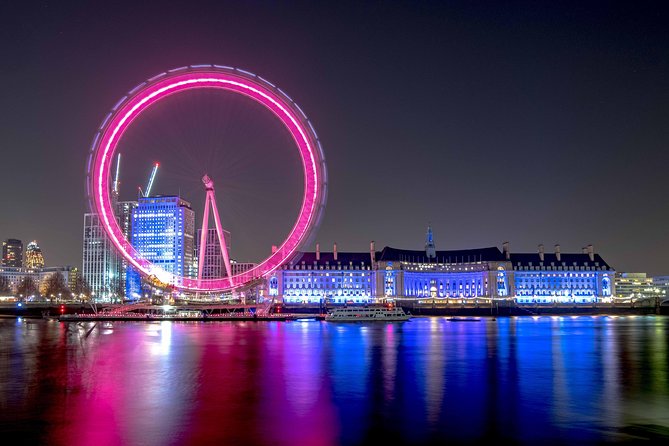
The London Eye is an excellent first subject because it gives you several ways to practice. You can frame the wheel as a large circle against the night sky, include the river for balance, or use reflections and surrounding lights to make the image more layered.
This is also the place to experiment with exposure. A longer shutter speed can soften movement and turn passing lights into lines. If the wheel or nearby activity is moving, you can learn how to balance a sharp structure with controlled blur.
The river adds another useful element. Reflections are rarely perfectly still, so you can work with broken bands of color rather than trying to make every detail crisp. That is a good lesson in accepting movement as part of the picture.
David can also help you look beyond the obvious viewpoint. The most familiar image of the London Eye is not always the most interesting one. A change in angle, height, or framing can make a standard landmark photo feel more personal.
For smartphone users, this stop is especially practical. Modern phones can handle night scenes well when you keep them steady and choose a suitable night or long-exposure mode. You may not have the same manual control as a dedicated camera, but you can still learn how to frame lights, manage bright highlights, and use reflections.
Stop two: St Paul’s Cathedral after dark
St Paul’s Cathedral gives the tour a different type of subject. Instead of the circular structure of the London Eye, you are working with a solid building, strong symmetry, and architectural detail.
Here, the lesson moves toward composition. You can practice keeping vertical lines straight, placing the dome carefully within the frame, and using nearby streets or open spaces to create depth. Low light also makes you think about how much detail you need in the shadows.
St Paul’s is one of the places where a tripod becomes valuable. A long exposure can keep the building sharp while gathering more light, but holding a camera by hand often introduces blur. You may still take good handheld photographs, especially with a phone, but a tripod gives you more options.
The tour is not simply a parade of landmarks. You also work on camera functions that you can use elsewhere. One participant learned that their camera could make multiple exposure images, while another tried zooming the lens during a long exposure to create a more unusual effect.
Those techniques are not essential for a classic postcard photograph. They are useful if you want to develop a personal style and move beyond simply recording what is in front of you.
More Photography Tours in the UK
- London: Iconic Sights Photo Walking Tour
★ 4.9 · 12 reviews - Iconic London Photo Walking Tour
★ 4.6 · 11 reviews - A Professional Photo Walk Experience in London
★ 5.0 · 4 reviews - London Photo Tour with a Private Photographer
★ 5.0 · 3 reviews
Stop three: the City of London and creative angles
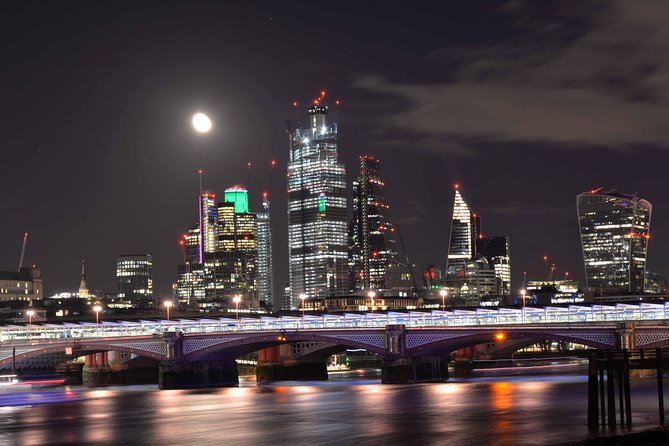
The City of London provides a change of scale and mood. Streets, offices, old buildings, modern structures, and passing traffic give you plenty to work with. The point here is less about one single landmark and more about finding strong views in an urban setting.
This is where David’s local knowledge can save time. He can point out less obvious corners and help you find a better angle rather than leaving you to wander with a tripod while the clock runs down.
You may practice light trails from passing cars, reflections on wet surfaces, or frames that combine older architecture with newer buildings. The creative goal is to notice patterns, lines, and movement instead of treating the city as a collection of isolated monuments.
This part should appeal to photographers who want more than the standard London checklist. You still see major sights, but you also get encouragement to search for small scenes within the big city. That can be the difference between a record shot and an image with atmosphere.
If you are new to manual controls, this section may feel like a lot at first. David’s instruction helps, but you should not expect to master every setting in one evening. The useful result is a better grasp of what to try next time.
Stop four: Tower Bridge and moving light
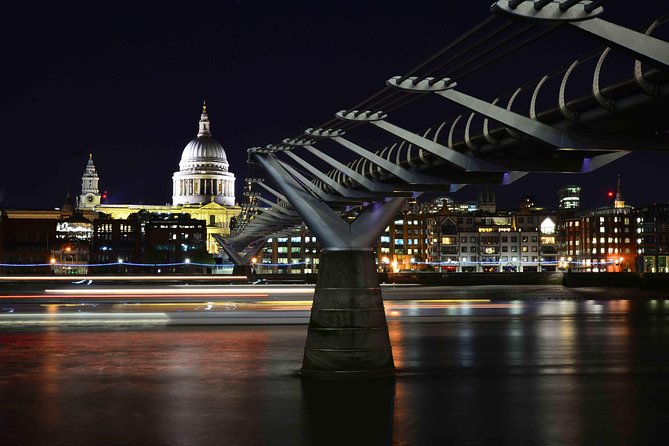
Tower Bridge is likely to be the strongest finish for night photography. Its towers, suspension lines, river setting, and illuminated structure give you several clear compositions.
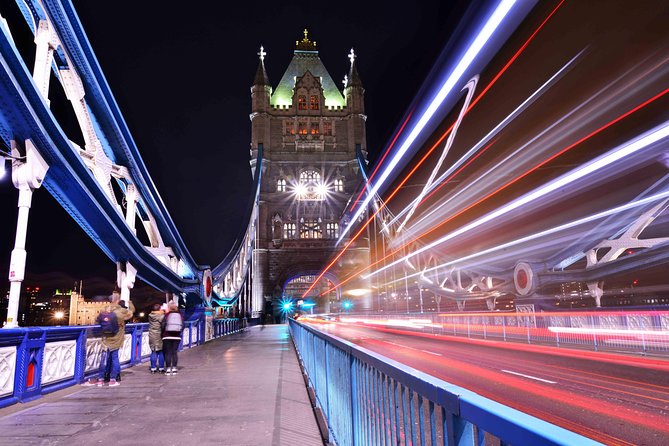
A wide view can show the bridge in its setting. A tighter frame can emphasize the stonework and repeating lines. From the river, you can include reflections, boats, and the colored movement of traffic.
This is also a natural place to practice long exposures. The bridge itself remains steady while boats and cars become soft trails. With a tripod and careful timing, you can create an image that feels very different from a quick handheld snapshot.
You should expect to take several versions of the same scene. Night photography is often a process of adjusting shutter speed, aperture, ISO, focus, and composition. A guide can shorten that learning curve, but the camera still needs time to collect the light.
Tower Bridge can be busy, and there may be many possible angles. The private format should make it easier to ask for help or pause for another attempt. Still, the tour has a fixed duration, so you may need to choose between trying a creative technique and moving on to another view.
What David teaches you along the way
The strongest part of the experience is the practical coaching. David helps with more than pressing the shutter. You can expect guidance on framing, camera settings, low-light shooting, long exposure, and the creative choices that make a photograph feel deliberate.
His help is not limited to one brand of equipment. A Canon user and an iPhone user can work on the same scene while using different controls. If you have a camera system with menus you do not know well, bring it with the battery charged and be ready to explain what you already understand.
The session also covers ideas that remain useful during the day. The lessons on composition, small changes in settings, and choosing a viewpoint are not limited to night scenes. One of the best reasons to book this kind of experience is that the instruction can improve ordinary travel photography after you leave London.
You should tell David your level at the start. A beginner may need help with basic exposure and camera controls. An experienced photographer may want to focus on creative effects, unusual angles, or refining a particular technique.
The teaching is described as patient and personal. One participant who lost the use of a camera battery was able to continue with an iPhone, and another received help after rain began. Those details suggest a flexible approach, though you should still dress for London weather and protect your equipment.
Camera, tripod, battery, and clothing advice
You can bring a DSLR, mirrorless camera, or smartphone. The tour is not limited to high-end equipment, and an iPhone can be used for night techniques and composition practice.
A tripod is the most important accessory if you want to work with long exposures. One participant had a tripod lost with airline baggage and was able to share a spare tripod supplied by David. That was a helpful solution, but bringing your own gives you more control and means you do not have to wait for another person.
Pack a fully charged battery and, if you have one, a spare. A charged phone is also sensible. You will use it for photos if your main camera fails, and it may be useful for staying in touch before or after the walk.
You should also wear comfortable shoes and clothing suitable for several hours outside. The route covers several central London sights, and the experience requires a moderate level of physical fitness. Food and drinks are not included, so eat beforehand or plan for refreshments separately.
Is $164.52 per person fair value?
At about $164.52 per person, this is not a cheap sightseeing walk. Its value depends on how much you want the photography instruction.
If you only want to see the London Eye, St Paul’s, and Tower Bridge at night, you can visit those areas independently for much less. You would also have complete control over your time and could take ordinary night pictures at your own pace.
The tour makes more financial sense if you want to learn. You are paying for a professional photographer, route planning, camera help, and practical instruction in several different settings. The photography e-guidebook adds something you can use later, and group photos are included.
A private booking can be good value for a couple, family, or small group that wants personal attention. The price becomes less attractive if you are already highly experienced with night photography and only need a guide to show you viewpoints.
The advertised format is private, with only your group expected to participate. However, one account described a session with three participants and referred to it as a group tour. If private, one-to-one instruction is essential, confirm the group arrangement before booking.
Who should book this night walk?
I would recommend it most strongly to:
- Smartphone photographers who want better night images
- Beginners learning manual camera controls
- Hobby photographers who want to practice long exposures
- Couples or small groups looking for a private evening activity
- Experienced photographers who want new London viewpoints
- People who prefer learning through guided practice rather than a formal class
It may not suit you if you dislike walking outdoors at night, do not want to carry a tripod, or only want a quick set of landmark photographs. It may also feel expensive if photography is a minor interest rather than the main reason for booking.
The experience works well for mixed abilities. One person can use a Canon while another uses an iPhone, and both can work on the same scene at an appropriate level.
Booking details and cancellation
Confirmation is provided at booking, and the activity is offered in English. It is booked, on average, 22 days in advance, so reserve early if your London dates are fixed.
Free cancellation is available up to 24 hours before the start time for a full refund. Changes or cancellations made less than 24 hours before the start time are not accepted for a refund. The cut-off follows London local time.
Should you book it?
Book this tour if you want London night photography to be an active lesson rather than a simple evening walk. David’s coaching, the range of subjects, and the chance to use either a dedicated camera or a smartphone give the experience broad appeal.
I would be especially keen to book it if I had a new camera, wanted to improve my iPhone photography, or hoped to learn long-exposure techniques in real city conditions. Bring a tripod if you can, charge every device, and tell David what you already know.
Skip it if you only want sightseeing or if $164.52 feels too high for a two-and-a-half to three-hour activity. For anyone who wants better travel photos and enjoys learning as they go, this is a focused and useful way to see London after dark.
FAQ
Where does the photography tour start?
It starts at Caffè Nero, Unit B, Portcullis House, 1-2 Bridge Street, London SW1A 2JH, UK.
Where does the tour finish?
The activity ends back at the meeting point.
How long does the experience last?
The stated duration is approximately two hours and 30 minutes. The tour description also refers to a three-hour night tour, so allow roughly two and a half to three hours.
Which London sights are included?
The route includes the London Eye, St Paul’s Cathedral, the City of London, and Tower Bridge.
Can I use a smartphone instead of a DSLR?
Yes. The experience is suitable for a DSLR, other camera types, and smartphones such as an iPhone.
Is the tour private?
It is presented as a private activity for your group. One session included three participants, so confirm the exact group arrangement if private instruction is important to you.
Is a tripod included?
A tripod is not listed as an inclusion. One participant was able to use a spare tripod brought by David, but bringing your own gives you more flexibility.
What is included in the price?
The price includes the photography tour, a photography e-guidebook, and tour and group photos. Food and drinks are not included unless specified.
What is the cancellation policy?
You can cancel up to 24 hours before the experience start time for a full refund. Cancellations or changes made less than 24 hours before the start time are not accepted for a refund.
More Private Photoshoots in the UK
- London: Private travel vacation photoshoot -Romantic Special
★ 4.7 · 50 reviews - Professional Private Couple Photoshoot
★ 5.0 · 35 reviews - London: Private Couples Photography Session with Landmarks
★ 5.0 · 16 reviews - London: Private Photo Session in Westminster
★ 4.9 · 16 reviews
More Private Photoshoots in London
- London: Private Photoshoot with Video Clip Option
★ 4.8 · 182 reviews - Private landmarks photoshoot for families and couples
★ 5.0 · 92 reviews - London: Private Landmark Tour with Professional Photographer
★ 4.7 · 91 reviews - Professional Private Photoshoot in London
★ 5.0 · 63 reviews
Just added around London
- London 1- or 2-Hour Professional Photo Shoot★ 4.9 · 6 reviews
- London: West End Photography Walking Tour with Guide★ 5.0 · 2 reviews
- London: A Unique Photoshoot Experience at Famous Sites★ 4.6 · 22 reviews
- London: Private travel vacation photoshoot -Romantic Special★ 4.7 · 50 reviews
- London: Private Photo Session at Iconic Landmarks★ 5.0 · 6 reviews
- London: Private Couples Photography Session with Landmarks★ 5.0 · 16 reviews
- London Photo Tour with a Private Photographer★ 5.0 · 3 reviews
- London 60min PRIVATE Personal Vacation & Travel Photographer★ 5.0 · 5 reviews
Night & Astro Photography, compared.
Tokyo by Night Photography Tour (Private Option Available)
Read our review →
Night Photo Session in a Fiat 500 with Aperol Spritz
Read our review →